
The N-Word in Schools: Strategies for Addressing a Persistent Problem
Multicolored conversation bubbles
For a free downloadable PDF version of this post visit www.justiceleaderscollaborative.com/store.
Introduction
I am a co-founder of Justice Leaders Collaborative & Press–an organization that, among other things, provides professional development to schools and educators focused on dismantling oppression, cultivating justice, and nurturing wellbeing. I am also the author of multiple books for children and adults about race, racism, and racial justice.
Over the past decade and a half, some of the most common calls for help my colleagues and I have gotten are from educators concerned about how they should address the prevalent usage of the N-word among students in their schools. We are asked so frequently about this issue that I am convinced virtually every middle and high school in the country is probably dealing with it (and likely some elementary schools). Unfortunately, the problem seems to be getting worse.
It makes sense that schools are struggling with how to address the N-word because while it is rooted in the worst history of our country, it is alsoubiquitous in modern American popular culture. Adding to the complication for schools is the reality that America more broadly hasn’t successfully figured out how to navigate this word–or the racism that created and sustains it. Moreover, we are living in a time of increased political polarization. White Americans in particular, who make up the overwhelming majority of U.S. teachers (over 90% in the state where I live), often:
lack deep knowledge or understanding of the history and present reality of racism in our country;
lack deep relationships across race that have forced them to wrestle with questions of when, how, and by whom the N-word should be used; and as a result,
have not developed a broader philosophy for confronting this issue.
And yet, these teachers are generally the ones tasked with responding when the N-word arises in their schools. In most cases educators either ignore the word or respond in panicked reactionary ways that don’t create lasting cultures of justice. Instead, schools and educators should be proactively anticipating what we know to be a common and perhaps inevitable occurrence. Students in U.S. schools are going to say the N-word. We should be prepared to teach them about the origins and ongoing issues surrounding the word, and we should be capable and practiced in interrupting its usage.
My hope is that this essay will help you better understand the history of the N-word, the complicated ways it continues to appear in our schools, and the steps we should take to address it more effectively.
The History of the N-Word
The history of the N-word is arguably as long as the United States itself. It has become one of the most fraught words in our country, our most enduring racial slur, a source of national student protests, and the topic of entire books (1).
The N-word was preceded by the practice of referring to African-descended people as “negro” or “negros” — the the Spanish and Portuguese word for the color “black” (derived from “niger,” the Latin word for the color “black”). Beginning in the late 1400s and early 1500s, many European countries, including Spain, Portugal, and Britain, began the transatlantic slave trade in which they kidnapped and enslaved people from West Africa and sent them on ships to work as free labor on lands in North, Central, and South America that they had stolen from the Indigenous peoples already living there. Colonizers called these kidnapped Africans “negro” or “niger”–Black–due to the generally darker color of their skin in comparison to European-descended people.
Over hundreds of years of enslavement, these descriptive terms evolved into words like “n*gger” and “n*gga” used by White colonial Americans as intentional and overtly derogatory slurs to dehumanize enslaved Africans (2). The word was meant to invoke the false idea that, unlike White Americans, Black Americans were inherently unintelligent, lazy, slovenly, and violent–closer to apes than humans–and as a result, were fully deservingof the horrendous conditions under which they were forced to live and work for hundreds of years. In fact, many White American leaders framed enslavement as a good thing that saved African-descended people from their own animalistic tendencies by teaching them how to be more “human.” Ironically, they were literally being treated worse than animals by these supposed saviors.
In the late 1800s and early 1900s, usage of the N-word as a derogatory racial slur increased as part of the broader backlash against the issuance of the Emancipation Proclamation in the 1860s which ended slavery in the U.S. This backlash not only included a ratcheting up of racist language but also an increase in lynching and other forms of violent intimidation targeted at Black Americans by racist White mobs.
The word also became prevalent in American popular culture. The Adventures of Huckleberry Finn, published in 1884, used the N-word over 200 times. Gone with the Wind, published 50 years later in 1936, used the N-word over 100 times. In 1966–over 100 years after slavery had been legally outlawed–Dr. Martin Luther King, Jr. wrote a letter commenting on the continual usage of the word in American vernacular noting, “The word ‘n*gger’ carries with it a meaning deeply rooted in the debilitating racist caste ordering of our society’s slavery epoch and segregation era.” Dr. King was writing during the first time in nearly a century (3) that there was even the pretense of racial equality in the United States (4). For the vast majority of the hundreds of years prior to this time, racism was simply the law and culture of the land.
And now, even 60 years after the gains of the Civil Rights Movement, the N-word remains in American vernacular as many things–a racist slur, a “transgressive” word that some feel excited about using (see the White filmmaker Quentin Tarantino’s use of the word by both Black and White characters in movies ranging from Pulp Fiction to Django Unchained), and as a word commonly used within the Black community in a multitude of ways.
[To help your students learn more about Dr. Martin Luther King, Jr. download our free resource Redesigning Dr. Martin Luther King, Jr. Day for Equity and Justice]
A Note about “Race” & Racism
What has made the N-word especially toxic is the way it has reinforced the false idea that there is something inherently different and deficient about Black people in comparison to White people–that they are essentially a different species. The truth is, “race” itself is a made-up idea.
As we now know, all humans are biologically the same species. Each individual human is 99.9% genetically identical to every other human on earth. And every human on earth has shared ancestors that evolved on the continent of Africa. In fact, two people of the same so-called “race” often have more genetic diversity than two people from different races.
Even when it comes to the physical differences we observe between humans, the idea of “race” doesn’t neatly capture them. There is no single physical trait that is found in only one so-called “racial group.” People of various racial backgrounds can share the same skin color, eye shape, or hair texture.
For example, having high levels of melanin–which makes you browner–provides protection from the sun and is not owned by any one race. Any population whose ancestors remained in sunnier places closer to the equator tends to be browner than populations that evolved in colder climates — this includes people who are African descended, South Asian, and people Indigenous to the Americas. Because skin color is an evolutionarily adaptation to the sun (our need for the Vitamin D it provides as well as our need for protection from its UV Rays) northern Asian populations that got lots of Vitamin D from their diets but also lots of UV Rays bouncing off of snow also remained fairly brown. Conversely, people in colder parts of Europe and Asia who did not consume as many Vitamin D rich foods eventually evolved to have lighter skin so that they could capture as much sunlight as possible on the little bits of their skin that remained exposed in colder temperatures.
Moreover, the physical differences we notice about each other are only a miniscule part of the tiny amount of genetic variation between humans. Unfortunately, we often overweigh these supposed differences as having essential relevance to who we are because they happen to be the things we can see.
The lie of race doesn’t just apply to our physical bodies. It is also the case that there is no intellectual trait or skill that any one so-called “race” is collectively better at than any other. Intelligence in math, writing, and science is found in people of every single racial group on the planet. People on every continent on earth (with the obvious exception of Antarctica) developed advanced civilizations prior to European colonization. Individuals of every background are amazing artists and athletes. At a fundamental level, it is true that “there’s only one race–the human race.”
To the extent that we observe one racial group doing better or worse when compared to others, it is generally due to systemic differences in access to opportunity. For example, given that Black Americans were denied the right to own property for hundreds of years, and in fact were forcibly and violently made to work for free in ways that benefited White Americans across generations, it makes sense that today White Americans on average have accumulated significantly more wealth than Black Americans. Not because there’s anything uniquely wrong with Black people or anything uniquely right with White people, but because our country created systems in which one group was financially advantaged for hundreds of years while the other group was financially disadvantaged. We call this process in which one racial group is systematically advantaged over others “systemic racism” — racial inequality that is literally baked into the system.
So, if race has no real basis in biology or ability, what is it? Fundamentally, race is a made-up way of categorizing people based on historic geography–where our ancestors lived after humans began leaving Africa (but before the era of global colonization beginning in the 1400s and 1500s). “Black” really just means “African descended.” Similarly, “White” really just means “European descended.” The purpose of this categorization has historically been to justify the treatment of some groups as inferior and some groups as superior–to justify racism. In reality, the labels don’t really say anything useful about human difference at any biological or fundamental level.
It’s worth noting that this geographically-based way of grouping people is fraught because we all have tons of ancestors that very well may have come from many different places. Moreover, our made-up racial categories change over time (take a look at how U.S. census racial categories have changed every ten years since the 1700s) and are different in different countries (not every country on earth uses the same racial groupings as we do here in the U.S.; take a look at the racial grouping used in South Africa or Brazil). When something exists only in our collective imagination it’s not surprising that the rules and boundaries keep changing.
In sum, race is a made-up idea that has allowed people to perpetuate and accept the mistreatment of their fellow humans. And racist words–the N-word being the most egregious, pervasive, and enduring in our society–were developed to solidify these faulty, inaccurate, and problematic beliefs about our supposed differences within the very language we use to talk about each other.
Modern Usage of the N-Word in Schools
The N-word remains prevalent in our society and is used in a number of different ways:
Intentional Racial Slur or Hate Speech
The N-word continues to be used in America as a racist slur–a way of denigrating and dehumanizing Black Americans to suggest that they are of lesser value than White Americans. Students, and even adult staff, may be using the N-word in these intentionally racist ways, especially if they come from families or communities where racism is part of the underlying ideology.
In-Group Term
Among Black Americans the N-word is also prevalent. Like many other groups who have adopted and reclaimed words rooted in discrimination as “in-group” language meant to navigate an oppressive world, many people in the Black community have reclaimed the N-word, often pronouncing it with an “a” at the end rather than the “-er” or “hard r.” Within Black communities, the word can mean a range of things–from a term of affection for a “friend” or “brother,” to a derogatory term meant to distinguish Black people deemed acceptable from those deemed unacceptable. Not unlike language in many different communities (think the B-word among women or the F-word among the LGBTQIA+ community), there continues to be a lot of debate and disagreement about the usage of the word within the Black American community. Is it a term of endearment? Empowerment? Is it malicious? Does pronunciation matter? Does it matter who overhears it? Does gender matter? Does class matter? And more.
Casual Out-Group Usage
There are many ways that non-Black people who are not intending to be overtly racist also casually use the N-word.
Music & Popular Culture: The N-word is widespread in popular culture. Rap and hip hop are often littered with the word, as are many movies and TV shows. While the word is predominantly used by Black artists in these contexts, some White musicians, filmmakers, and TV writers have also been known to use and include the word. This means that if non-Black people sing or rap along to many popular songs, it is likely that they will come across the N-word and have to decide if they will or will not say it. Moreover, social media is rife with the word. The N-word is everywhere in popular culture, and so students and staff of all races are often being inundated with it on many fronts.
Out-Group “Pass”: Many non-Black students also use the word claiming that they are doing so in ways similar to how some Black Americans use it–as a term of affection or as evidence that they are “cool.” Often (though not always) these students are not trying to be overtly hateful. Instead, as young people do, they are pushing boundaries, navigating how to interact across differences, playing with taboos, and perhaps having fun with transgression. However, despite their intentions, the risk of harm is always there.
While most people agree that the history of the word means non-Black Americans should never use it under any circumstances–the predominance of the word in culture has led to things like White students asking Black students if they can have an “N-word pass.” Sometimes Black students tell their own White friends that they are exceptions who are allowed to use the word because they’re deemed cool enough to do so.
Unsurprisingly, the getting and asking of permission for White people to use the word is fraught. What do Black students risk socially if they express discomfort at White students using the word? Have any of these young people thought deeply enough about the word to decide who does and doesn’t get to say it? Can one Black student “speak” for the entire Black community in giving a White student a “pass”? Is permission happening under duress? Does one Black person saying they’re okay with a White person saying the word actually make it okay? How are these interactions setting students up for success in the larger society? How do these interactions model authentic relationship-building across race?
Repeating What Someone Else Has Said: One final way the N-word is spoken in schools by people from many different racial backgrounds is by repeating or reporting on what another person has said. For example, when a teacher is trying to interrupt students using the N-word and they themselves use it in explaining what happened; or when a news reporter says the word while recounting something racist someone else did.
It also sometimes happens that students repeat the word after hearing it at school without having any knowledge of its history or meaning. For example, we have gotten reports of English Language Learners using the word because they think it means “friend” without understanding the specific racial context of the word in the United States. While these examples of repetition are often not intended to be harmful, the impact often is, in fact, harmful.
Literature & Texts
The final way the N-word comes up in schools is in literature and texts that students are required to read. High schoolers especially are often assigned books that have the N-word in them, which means teachers and students are having to figure out how to discuss the word in classes. Often teachers (the overwhelming majority of whom are White) read the word aloud, too frequently without adequate preparation for the students who will be hearing the word, or without consideration for how it may be harmful, especially to Black students. In some cases, White teachers feel their willingness to say the word in their classroom is evidence of their comfort with issues of race. It is often also the case that students themselves, from various racial backgrounds, are being asked to participate in read-alouds in which they are required to say the word with little preparation or regard for their own comfort, harm, or lack of power to object.
What Schools Should Do About It
Let’s cut to the chase. Our general advice is that the N-word should not be spoken in schools (5) regardless of usage or user. This means it shouldn’t be read aloud in a high school English class, it shouldn’t be said among friend groups (regardless of race), it shouldn’t be sung in hallways, and it shouldn’t be repeated when explaining what someone else said. The reality is the N-word is simply too fraught–especially in integrated, interracial settings like schools–and its history and present reality too damaging and harmful for it to be appropriate school language. It still may be true that in Black families, homes, or communities the word is used in ways that they find acceptable–just as some women use the B-word among friends. But school is not home. Just as educators have standards of language around cuss words, it’s okay to decide, “We don’t use that word here.” So how can schools put this principle into practice?
Proactive Preparation
If you work in a school in the United States, your chances of having issues with the N-word are basically guaranteed, especially as our country becomes even more polarized. This means you should expect it to happen and prepare in the following ways:
Clarify Purpose
As a staff you should get clear about the purpose of schooling. This may seem like a cheesy activity but wrestling with why we as a country send our children to spend hours a day in school buildings can help you navigate what to do about the N-word. At Justice Leaders Collaborative we argue that there are 3 core purposes of public schooling:
To prepare students to live successfully in a diverse, multiracial, multiethnic, multicultural democracy–this means helping them navigate the language they use when it comes to discussing race and interacting within and across it.
To provide students with the skills to take care of themselves and their communities–this includes helping students think critically about the language we all use and why.
And finally, to provide students from all backgrounds with a psychologically and emotionally safe place to spend their time–this means our schools can’t be rife with racial slurs!
If your purpose is in the same ballpark as what we suggest, it becomes clear that we need to address the N-word head on.
Build Culture: Guidelines, Relationship Building & SEL
The next thing you should have in place in order to adequately address the issue of the N-word in your schools is a broader culture that supports authentic relationship building and creates space for difficult dialogue across difference. Quite honestly, if you haven’t invested in relationship and culture-building it’s going to be difficult to address the N-word successfully. This means things like:
having classroom and community norms and guidelines (one that we use often is asking people to “be aware of intent and impact” as a means of inviting people to not just consider what they intended or meant with language such as the N-word, but also the impact it could have on others and on the larger school culture);
investing in relationship building among students and staff (we have a free tool called The Relationships Initiative that can help you do this!) and in a culture in which you are all committed to caring for each other (our picture book Care: A Short Guide to Caring & Sharing and accompanying free activities get at this);
investing in social emotional learning so that students and staff can adequately name and identify how they feel about the N-word and about the racial dynamics in their school (see our picture book Feel: A Short Guide to A Lot of Emotions and the accompanying free activities); and
intentionally celebrating and accepting difference and diversity (our picture book Bodies: A Short Guide to How We’re Different and accompanying free activities get at this).
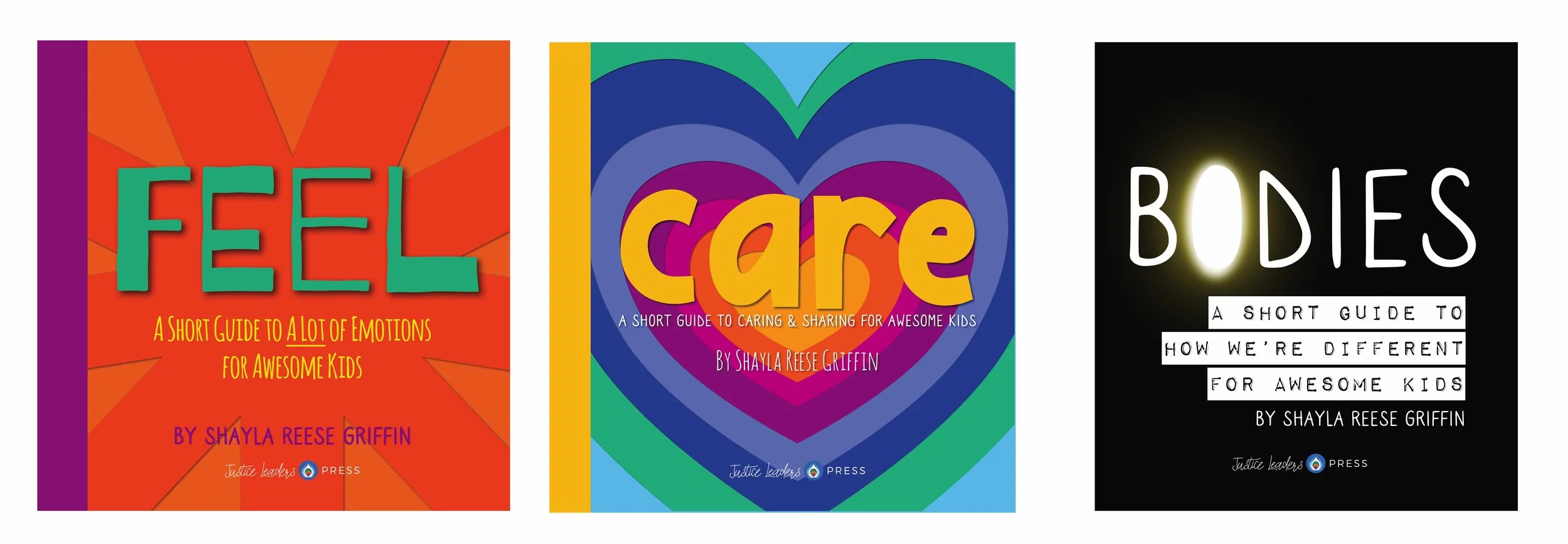
Image of book covers for “Feel,” “Care,” and “Bodies”
[Visit our YouTube page for read alouds of our books]
Establish Policies
Next, you should establish and disseminate clear policies about inappropriate language, slurs, hate speech, and cuss words in your school or district (and it should be clear that the N-word, in all of its forms including with -er and -a endings, is one of these words). Students and families should know exactly what the expectations are around school language and what the process is when there is consistent failure to meet these expectations. These school and district level expectations should also be reflected in individual classroom rules and norms.
Similarly, there should be clear policies and expectations for teachers charged with teaching content in their classrooms where the N-word will come up. Make sure everyone knows that the expectation is that they will not say the actual word and can instead use the term “N-word.” Just as with students, there should be clear processes if adults violate this expectation. Be consistent and have a standard protocol for when this happens that takes into account issues of unconscious bias.
Develop Curriculum & Lessons
One of the primary reasons the N-word is so fraught in schools is because we fail to teach or learn much about the word or the racism that undergirds it. Go back to the short section above on the history of the N-word and the note about “race” and racism. How much of this content do students learn in your P-12 schools? (How much did you learn in your P-12 schools?) When do they learn it? Before or after they’ve already started throwing the N-word around?
The N-word is such a taboo among young people in part because it is one of the ways in which they are navigating relationships across and around race. When schools fail to provide them with other opportunities to wrestle with the reality of race in their lives and relationships such “play” becomes a primary outlet for doing so.
[See my book Those Kids, Our Schools: Race and Reform in an American High School for more on this.]
We cannot expect students to appropriately navigate this word or the racist dynamics surrounding it when we give them no tools to do so! Something we say at Justice Leaders Collaborative is that we actually have to intentionally teach students about the history and present reality of race and racism if we want them to live into racial justice! We cannot achieve the purposes of schooling if we fail to do this.
For example, if you know that your middle school students are experimenting with the N-word (Hint: They are!), then every single 6th grader in your district should go through a unit on race in which they learn about the N-word and more! Middle school orientation should directly address the history of and expectations regarding the N-word and other slurs and derogatory language. For way too many schools and educators, this is something we’re doing after an incident has happened (if at all). Instead, this content should be a standard part of our curriculum and processes for acclimating middle and high school students–and possibly even older elementary students. If it were up to me, we’d go beyond race and also do units on issues of justice related to class, gender, ability, and more.
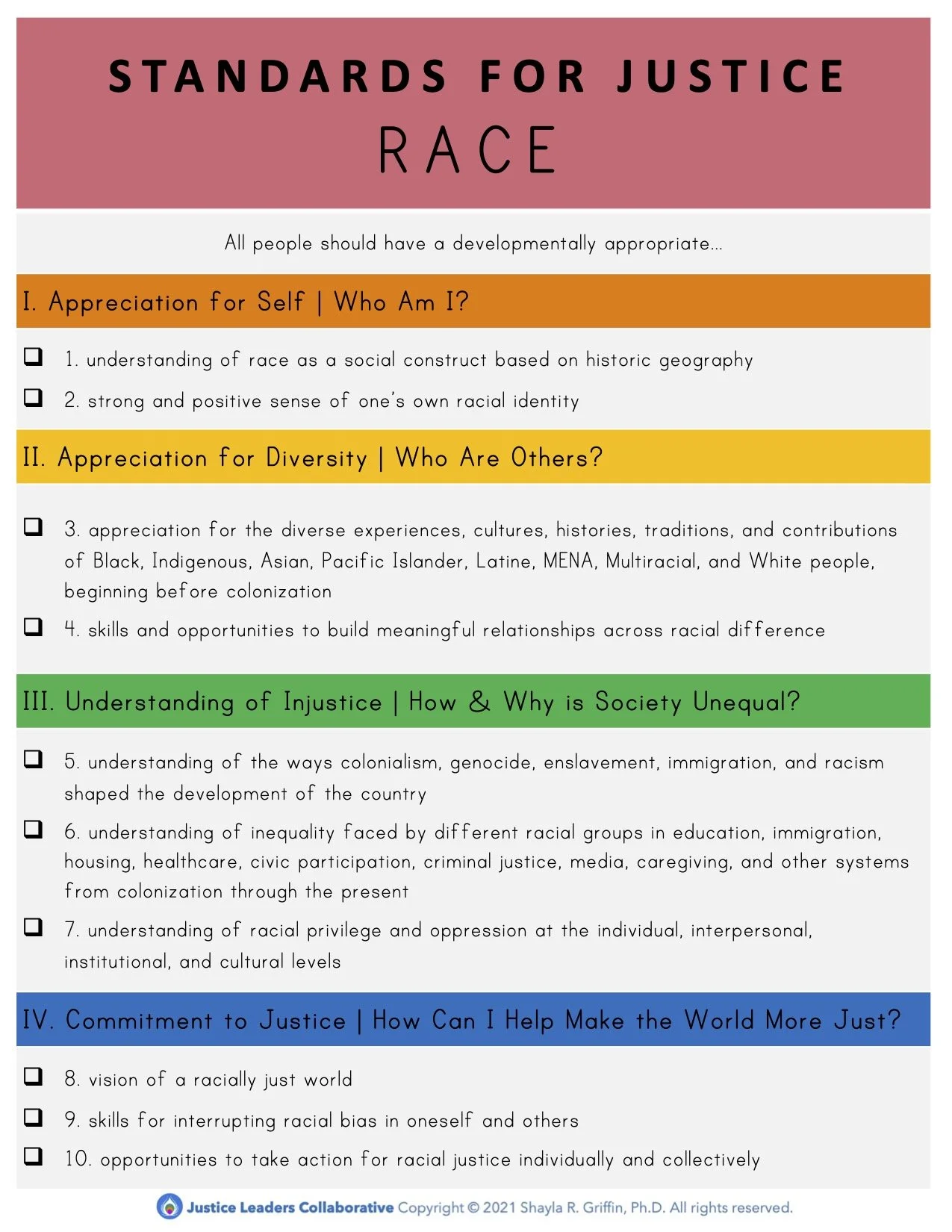
Standards for Justice: Race
At Justice Leaders Collaborative, we have created a set of K-12 Standards for Justice for discussing race. I’ve also written two children’s books about race, Together: A First Book about Race for Awesome Kids and The Awesome Kids Guide to Race, (available on our website and at most major online retailers including Bookshop, Barnes & Noble and Amazon) along with a checklist for antiracist action. These resources are intended to help you engage your students from Kindergarten and beyond in conversations and learning about issues of race and racism.
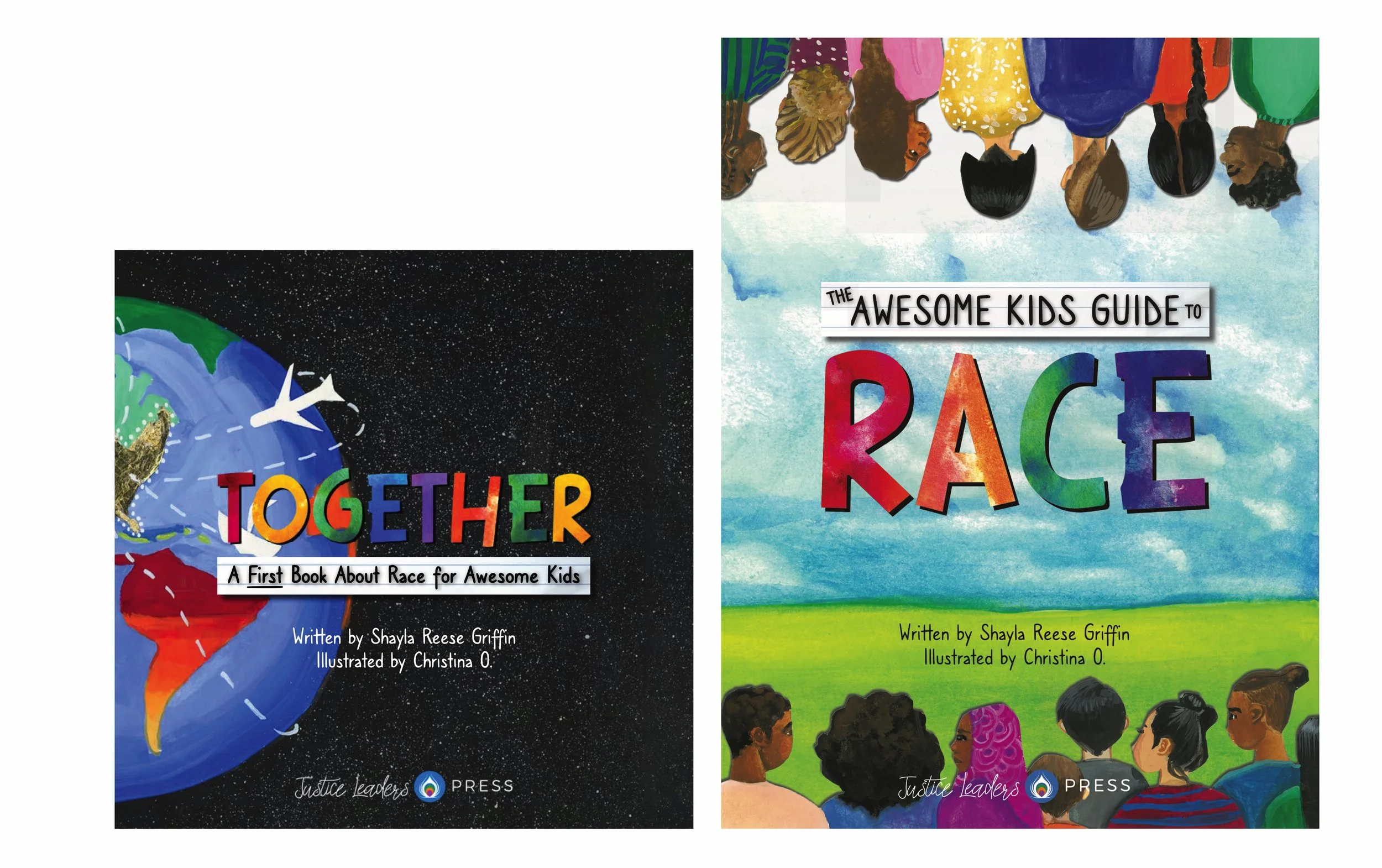
Image of book covers for “Together: A First Book about Race for Awesome Kids” and “The Awesome Kids Guide to Race”
Train Teachers
It is very possible that the biggest barrier to addressing the N-word in your school is that educators are uncomfortable and/or uninformed about the word. As a result, you may need to provide professional development or training to help the adults gain the knowledge and skill they need to teach, interrupt, and engage with students about this content. And they may need support in engaging students in these conversions. We have courses at Justice Leaders Collaborative intended to help with this (my book Race Dialogues: A Facilitator’s Guide to Tackling the Elephant in the Classroom may also be a useful resource).
Responding to Specific Incidents
After you’ve set yourselves up for success by creating a culture and curriculum that supports racial justice and prepares the educators in your school to be leaders in this effort, you should strive to interrupt incidents on the spot. In general, when the N-word is said in schools in practically any context you can simply respond, “That is not acceptable school language. We don’t use that word in this school.”
It is perfectly fine to have expectations of acceptable language within a school building for the common good–especially if you are in a multiracial setting in which you are trying to keep students from a range of backgrounds physically, emotionally and psychologically safe while preparing them to successfully interact and build relationships across difference. Sometimes educators get confounded by pushback they may receive from students asserting their desire or “right” to continue using the word, but this response holds even in those conversations.
How to Respond to Casual Usage of the N-Word
If Black students are using the word in in-group ways, you should generally treat it as if they’d said a cuss word at school and simply use the standard line about it not being appropriate school language. Point it out, redirect, then keep it moving. If they push back when you interrupt by saying something like, “But I can say it! I’m Black” or “I say it all the time at home,” educators should respond with something like, “Yes, there are lots of conversations about this word and its acceptability. In this school though, it is not a word we use. Please don’t use it again here.”
If a non-Black student uses the word casually (singing along to a song, as evidence that they have Black friends, or repeating what someone else has said) you can respond similarly: “That is not appropriate school language, please do not use it again.” If appropriate to the situation, you could add information about how the N-word has had a specifically harmful and racist history when said by non-Black people, especially White people.
Let’s say a White student says they’ve been given permission to use it by a Black peer. Educators can respond, “Actually no student in this building can give permission to say a word that according to our policies is not acceptable school language. We don’t use that word in this school. Please do not say it again.” (This only works if you actually have a policy about unacceptable language that includes the N-word.) If you have more time, you can help them understand that even if an individual Black student is okay with a non-Black student using the word (which can be hard to know as the social pressure to acquiesce often underlies such “passes”), that doesn’t mean all or even most Black people would find it acceptable; moreover, you (regardless of your own race) don’t find it acceptable! To be clear: it is not up to Black students–especially at an individual level–to decide what the standards of language should be in a school.
If a student continues using the word in school, further learning is needed. If you’ve implemented a curriculum already that addresses this, a reminder may be in order. If you haven’t done so at a school-wide scale you should have lessons developed that you can utilize as needed when the word comes up and you should be clear about which adult is helping students learn this information. Some schools have done a kind of replacement for “In School Suspension” in which the offending student is pulled out to learn more about the history and reality of the word. Again, the goal is not to punitively punish the student–after all, many elements of our culture have taught them to use the word. Rather, it’s an opportunity to fill in a gap of information that the student may have about why their language choices are harmful.
How to Respond to the N-Word in Historical Literature & Texts
If you are teaching a course in which students are going to be reading or engaging with literature or texts that contain the N-word, the best practice is to proactively discuss how you will deal with language in the course and then to ask anyone reading it aloud (students or staff) to simply replace the word with the term “N-word.”
While the harm of speaking the N-word aloud means that we should refrain from doing so, the word will continue to exist in literature and other documents that may be an important part of your curriculum. I am not suggesting you delete all written instances of the word–not only would that likely be impossible, it also potentially erases important historic context students should be wrestling with. Instead, the suggestion is that you make the decision not to speak it.
How to Respond to Intentional Racial Slurs or Hate Speech
If the word is being intentionally used in a discriminatory or demeaning way you should follow the policies set forth in your code of conduct for hate speech, bullying, or other intentionally harmful and violent behavior. To be clear though: suspensions and expulsions for racist language or hate speech do not ultimately address the issue of racism in our schools or our society. Creating opportunities for deeper learning and reflecting is always necessary if our goal is to change the hearts, minds, and actions of our students.
Repairing Harm
Finally, you should have clear methods for identifying and repairing harm in instances in which the N-word or other slurs are used, especially if people targeted by the word are distressed (regardless of the intention of the person who spoke the word). There should be a confidential reporting system in your school that allows students and families to share when something happens. And you should adopt approaches like Restorative Practices, opportunities for community members who have been victimized to express their feelings, and supportive services such as counselors and therapists who understand these issues to repair harm when students are victimized by racist language.
Conclusion
The N-word is rooted in a messy, racist history and continues to evolve in a messy, and too often racist, present. As products of the society in which we all live, our students (and many of our teachers) are trying to navigate the whos, whens, wheres, whys, and hows of the word. At the heart of this navigation is a larger struggle of how we grapple with race in this country, especially in multiracial public spaces like schools. If it is our intention to prepare our students to live and work productively in our diverse society, we must take much more seriously the need to engage them in learning and dialogue about race in America. Figuring out what to do about the N-word in our schools is an invitation to do just that.
Footnotes
(1) The N Word: Who Can Say It, Who Shouldn’t, and Why by Jabari Asim, Nigger: The Strange Career of a Troublesome Word by Randall Kennedy, and N: My Encounter with Racism and the Forbidden Word in an American Classic by James Henry Harris.
(2) While I have written out the N-word here to make clear how language has changed over time, if I were reading this essay aloud I would not actually say it in these forms. I would instead use the euphemism “N-word” any time I was saying it aloud.
(3) After slavery was outlawed, there was a period called the Reconstruction Era that lasted until around 1877. During this period there were significant efforts to at the federal level to outlaw racism and legalize racial equality. These efforts included the 13th Amendment ending slavery; the 14th Amendment which guaranteed birthright citizenship, due process & equal protection under the law; and the 15th Amendment guaranteeing men the right to vote regardless of race; as well as the Enforcement Acts and the Freedmen’s Bureau Acts meant to provide opportunities, access, and safety to Black Americans. However, these gains were met with prompt and aggressive backlash from White Americans and organizations like the Ku Klux Klan, leading to a reversal of this progress in little more than a decade.
(4) See the Civil Rights Act passed in 1964, the Voting Rights Act passed in 1965, and the Fair Housing Act passed in 1968.
(5) While this essay is specifically about schools, the N-word arguably shouldn’t be used in most all public institutions.
Shayla Reese Griffin, PhD, MSW is co-founder of Justice Leaders Collaborative & Press, which are committed to dismantling oppression, cultivating justice, and nurturing wellbeing through social justice training, consulting, resources, and books. Shayla is the author of many Short Guides for Awesome Kids including Feel, Care, Bodies and Outside; Together: A First Book about Race for Awesome Kids; The Awesome Kids Guide to Race; and the adult books Those Kids, Our Schools: Race and Reform in An American High School and Race Dialogues: A Facilitator’s Guide to Tackling the Elephant in the Classroom. She lives with her spouse and three children and gets her best ideas at 3 am.
Learn more about her work at www.justiceleaderscollaborative.com and www.justiceleaderspress.com.