
Redesigning Dr. Martin Luther King, Jr. Day for Equity & Justice: How Schools Can Do Right by MLK
Illustration of Dr. Martin Luther King, Jr. by MoMagic from Pixabay
For a free downloadable PDF version of this post visit www.justiceleaderscollaborative.com/store.
Every year in January, schools across the United States celebrate Rev. Dr. Martin Luther King, Jr. Day–a federally recognized holiday that seeks to honor the legacy of one of our greatest leaders for civil rights and racial justice. However, most people leave high school knowing very little about the man or the legacy of his fight for racial and social justice. In fact, most students graduate not only missing information about Dr. King and his legacy but also having absorbed 13 years of misinformation.
A better version is possible. Instead of spending year after year on the same rote lessons that fail to teach much at all, schools should be rethinking and redesigning how they use this time so that they can start doing MLK Day right and doing right by Dr. King!
Where Do We Go Wrong?: Too Shallow, Too Repetitive, Too Disconnected
Think back to the last MLK Day you celebrated. Perhaps it was when you were a student in a classroom; or maybe you were a teacher leading a classroom of students. What did you do? What did you learn? Now consider the year before that. What did you do that year? What did you learn? Now consider your present life. What exactly do you know about Dr. Martin Luther King, Jr.? What do you know about his amazing educational background and family life? What do you know about how his ideas changed over the course of his short life? What do you know about his position on issues of poverty, capitalism, and war? What do you know about how he was treated during his life by his fellow Americans and by the U.S. government? Which of his numerous speeches have you watched or listened to? How many of his many books and essays have you read?
While different teachers, schools, and districts do different things for MLK Day each year, there are some general trends that make this day a challenge for most educators across the nation.
Challenge 1 | First, there are no widely used curricula, standards, or scopes & sequences that provide guidance to teachers about what exactly they should be doing on this day. In the state where I live, the Social Studies Standards do not even address this period in U.S. history until high school! For innovative educators who are deeply passionate about Dr. King, this may provide the flexibility to truly innovate, but, for the majority of classroom teachers, it means scrambling at the last minute to do something that often feels like an “add-on” (because it is).
Challenge 2 | Second, because most educators did not learn much about MLK or his legacy in their own schooling experience, they actually don’t know much about him to share with their students. As the old adagegoes, “You can’t teach what you don’t know.”
Challenge 3 | A third common challenge when it comes to Dr. Martin Luther King, Jr. Day is that educators are often trying to teach about MLK when they haven’t taught students much about race or racism, and (as with challenges 1 and 2) they tend to have little direction and knowledge about how to do so. The reality is that in order to truly understand and engage with the legacy of Dr. King, students (and their teachers) have to understand what race actually is (hint: it’s not “skin color”); what racism is and how it has manifested in our country for hundreds of years; what racial justice and other forms of social justice are; and the role of the Civil Rights Movement in shaping U.S. history!
As a result of these challenges, most schools across the country celebrate MLK Day in the following three problematic ways:
Problematic Celebration 1 | In elementary schools, there is often an activity that goes something like this: “Dr. Martin Luther King Jr. had a dream! What is your dream?” Students then complete worksheets or art projects in which they write things like: “I dream of being a veterinarian!” Or “I dream of getting a new playground at our school!”
This activity is based on a very simplified, and I would argue inaccurate, interpretation of Dr. King’s most famous speech in which he uses the concept of “dreaming” to share his vision of a socially and racially just nation. Rather than focusing on King’s vision of justice, the focus is often on what it is to have a general “goal” or “dream.” Many classrooms devolve into a “what do you want to be when you grow up?” project or goal-setting activity. Students spend significant time thinking about their personal goals, hopes, and wishes in ways that may not at all be aligned with the actual work of Dr. Martin Luther King, Jr.; and they often do this year after year, learning no more about Dr. King, race, or racial justice than they knew the previous year.
Problematic Celebration 2 | A second common activity in elementary schools is to have students color a picture of Dr. Martin Luther King, Jr. While this may be a fun artistic endeavor, help support fine motor skills,and even give students an opportunity to use crayons and markers that reflect accurate human skin tones — all good things! — this activity alone does not teach students anything significant about the life and work of Dr. King.
Problematic Celebration 3 | A third common approach — used often in middle and high schools — is tomake MLK Day a “Day of Service” in which students and staff do a volunteer project of their choosing. Again, while it is a worthwhile endeavor to encourage students and staff to consider how they can use their skills, time, and resources to be of service in the world, doing this without opportunities to engage with the life and works of Dr. King is a missed opportunity. Students could leave their K-12 experience having done amazing service projects for 13 years and still know nothing about Dr. King or racial justice.
In short, too many schools are spending time every year saying they are celebrating the life and legacy of Dr. Martin Luther King, Jr. while doing very little connected to his specific life and legacy.
Over his short life, Dr. King wrote and gave over 2,500 speeches; wrote multiple essays and books; traveled across the country and around the world to lead peaceful non-violent marches and protests; and faced opposition from his fellow Americans and his own government that was so violent it led to his untimely death at the age of just 39. And yet, most students graduate from high school having read or watched very few of these offerings–perhaps none in their entirety — and are unclear about how his work is connected to their present reality. This is a failure of our education system that we should quickly work to rectify.
What Should We Do Differently?
Change 1 | We Should Clarify Our Purpose and Goals!
The current approach to MLK Day utilized by most schools is inadequate and ineffective. One of the reasons it’s difficult to plan for MLK Day is because many of us have not considered what the actual purpose and goals of celebrating the holiday should be.
We believe the goals should be two-fold. First, MLK Day should be an opportunity to learn about and reflect on the life and works of Dr. King. This means that we should actually be reading and watching him! Second, MLK Day should be an opportunity to reflect on how we can continue his legacy of fighting for racial, social, and economic justice in our own lives and time. This means that we should be learning about Dr. King in ways that connect to the present.
Getting clear as educators about “why” we are spending time on this day will help us make better use of it. Let’s consider what that would look like in practice!
[Helpful Tip: Consider spending time in your next staff meeting discussing the goals you have for MLK Day as a school, district, department, or grade level. Is what you’ve historically done on this day aligned with those goals? What could you do that would be more aligned?]
Change 2 | We Should Teach MLK in Ways Aligned with Standards for Justice!
Rather than quickly searching for “MLK Day Lessons” at the last minute or doing one of the problematic common activities listed above, individual educators should consider how their MLK Day lessons and units are aligned with efforts to teach issues of justice more broadly.
Justice Leaders Collaborative has developed “Standards for Justice: Race” in four areas that could be a useful guide (learn more about our standards and download them for free!):
I. Appreciation for Self | Who Am I?
II. Appreciation for Diversity | Who Are Others?
III. Understanding of Injustice | How & Why is Society Unequal (Past & Present)?
IV. Commitment to Justice | How Can We Help Make the World More Just (Past & Present)?
Such units and lessons should help students of all backgrounds:
understand and appreciate the racial identities of themselves, others, and Dr. King (Standards I & II);
understand how racism functioned at the time that Dr. King was alive as well as how it lingers in our society today (Standard III); and
develop an analysis of how Dr. King worked for racial and social justice in his own life and how they can carry on his legacy to further racial and social justice in theirs (Standard IV).
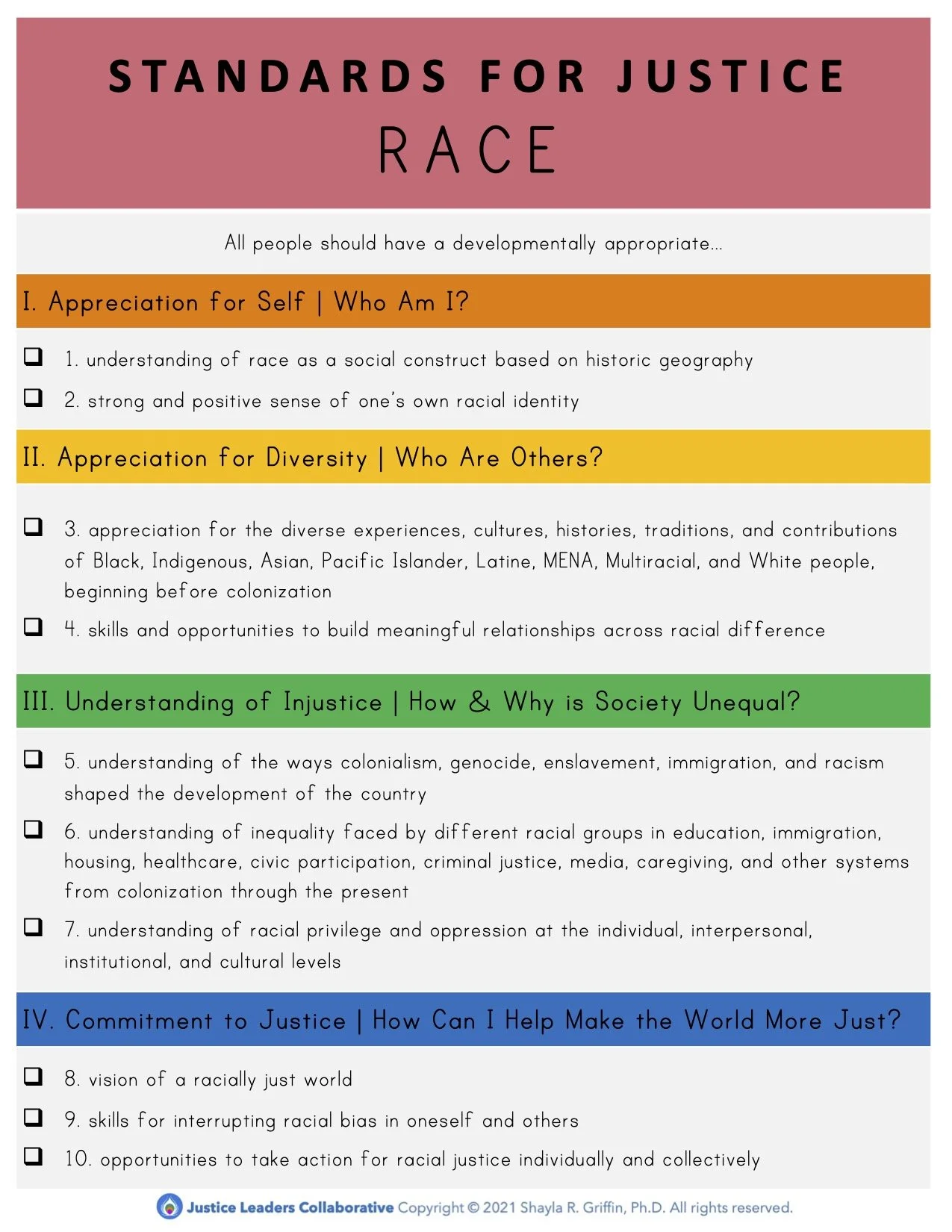
Standards for Justice: Race
I’ve written two books for children about race that support these standards. Together: A First Book about Race for Awesome Kids, specifically addresses the first two standards–helping students appreciate the racial diversity of themselves and others. The more advanced book, The Awesome Kids Guide to Race, covers all four standards — appreciating one’s own race and those of others, the history of racial injustice in our country, the work of activists throughout history to create a more just world, and the responsibility we all have to continue being a part of ongoing movements for racial justice — and comes with an accompanying checklist for taking action.
In addition to these two books about race and racism, I’ve also written:
Care: A Short Guide to Caring & Sharing for Awesome Kids–a picture book which may support your efforts to discuss what Dr. King meant by “Beloved Community” and his commitment to eradicating poverty and working for economic justice;
Feel: A Short Guide to A Lot of Emotions for Awesome Kids — a picture book which may help your students name the many emotions that are coming up for them as they learn about our difficult history; and
Bodies: A Short Guide to How We’re Different for Awesome Kids — a picture book which may support your broader conversations about diversity and inclusion.
These books are available in paperback, hardcover and ebook versions and some in coloring book versions aswell and are available most places books are sold online including Bookshop, Barnes & Noble, Amazon and the Justice Leaders Collaborative & Press website, where you can also downloadaccompanying free resources to support your lessons. You can also visit YouTube for book read alouds.
Our hope is that these standards, books, and resources will help you build a strong foundation upon which to improve your teaching about the life and legacy of Dr. King.
Change 3 | We Should Go Deeper!: Beyond the Same Short Clip
The next big problem with how we teach about the life and legacy of Dr. Martin Luther King, Jr. is that we generally do so in a very surface way. An easy solution is to simply go deeper! For example, rather than playing or reading the same tiny snippet of the “I Have a Dream Speech” every single year, consider how over the course of a student’s K-12 experience they could read or listen to and engage with the entire 17-minute speech (which actually covers many different topics and themes). What was the reason for the march where he gave the speech? Who organized this event? Who attended? Who else spoke? Who introduced Dr. King and why? What were the many different themes related to justice that he covered? Was this the first time he had given this speech?
You could take a similar approach with some of his other speeches or works. For example, his “Mountaintop Speech” (my personal favorite) could be a jumping off point for many different lessons over a number of years. It was his final speech, given the night before he was murdered, in which he spoke as though he knew his life would soon end. The speech is 40 minutes long–short enough to listen to in a single middle or high school class period and long enough to analyze over an entire unit or multiple years of schooling.
Dr. King was a prolific orator, writer, and thinker, and it does our students a grave disservice when we fail to engage deeply with his work. Not only are we limiting our students’ knowledge about Dr. King, we are failing to help them cultivate the essential critical thinking skills needed to carry on his legacy.
Change 4 | We Should Go Wider!: A Scope & Sequence for MLK Day
The next way educators should redesign their approach to MLK Day is by working collaboratively to develop a scope and sequence within your school or district. Every year, students should be building on their previous learning so that by the time they graduate they have actually engaged with a large swath of MLK’s philosophy, ideas, writings, and speeches, and have a deep understanding of the history and ongoing fight for racial and social justice in our country.
While this will take significant work on the front end, in the long run it is actually easier for classroom teachers. Instead of trying to figure out what you’re going to do each year, having a scope and sequence means teachers just need to deeply learn their particular lesson or unit and they can repeat it each year because they know their colleagues are also doing their part to expand students’ learning over time.
For example, a district could do something like what is laid out below.
[Note: While this chart shows a sample scope and sequence for K-12 learning, you could use a similar model to develop Unit Plans in which you cover much of this material in the same year or over fewer years; you could also consider which content best aligns with your other units and standards for your specific grade level or subject area].
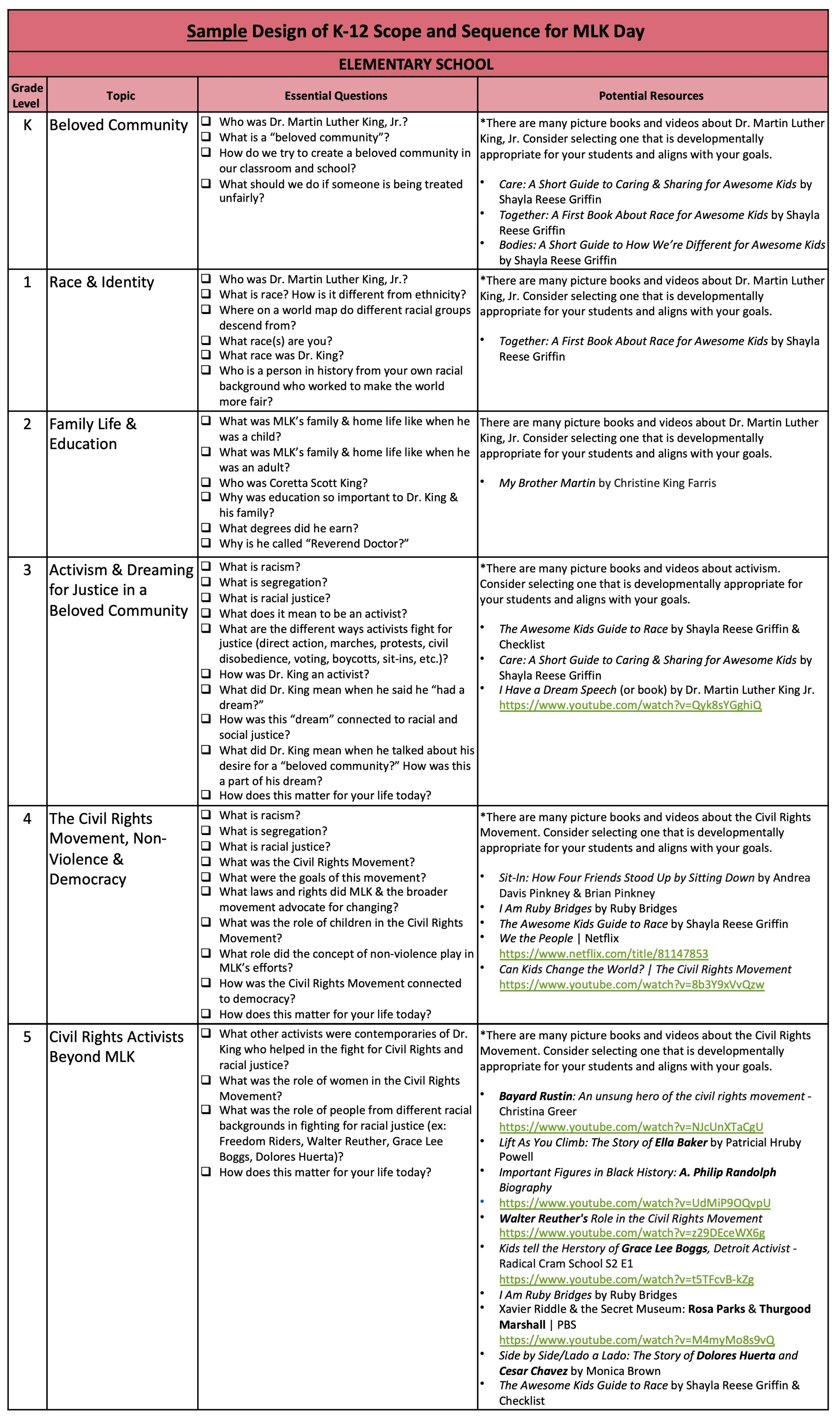
Sample Scope & Sequence Elementary
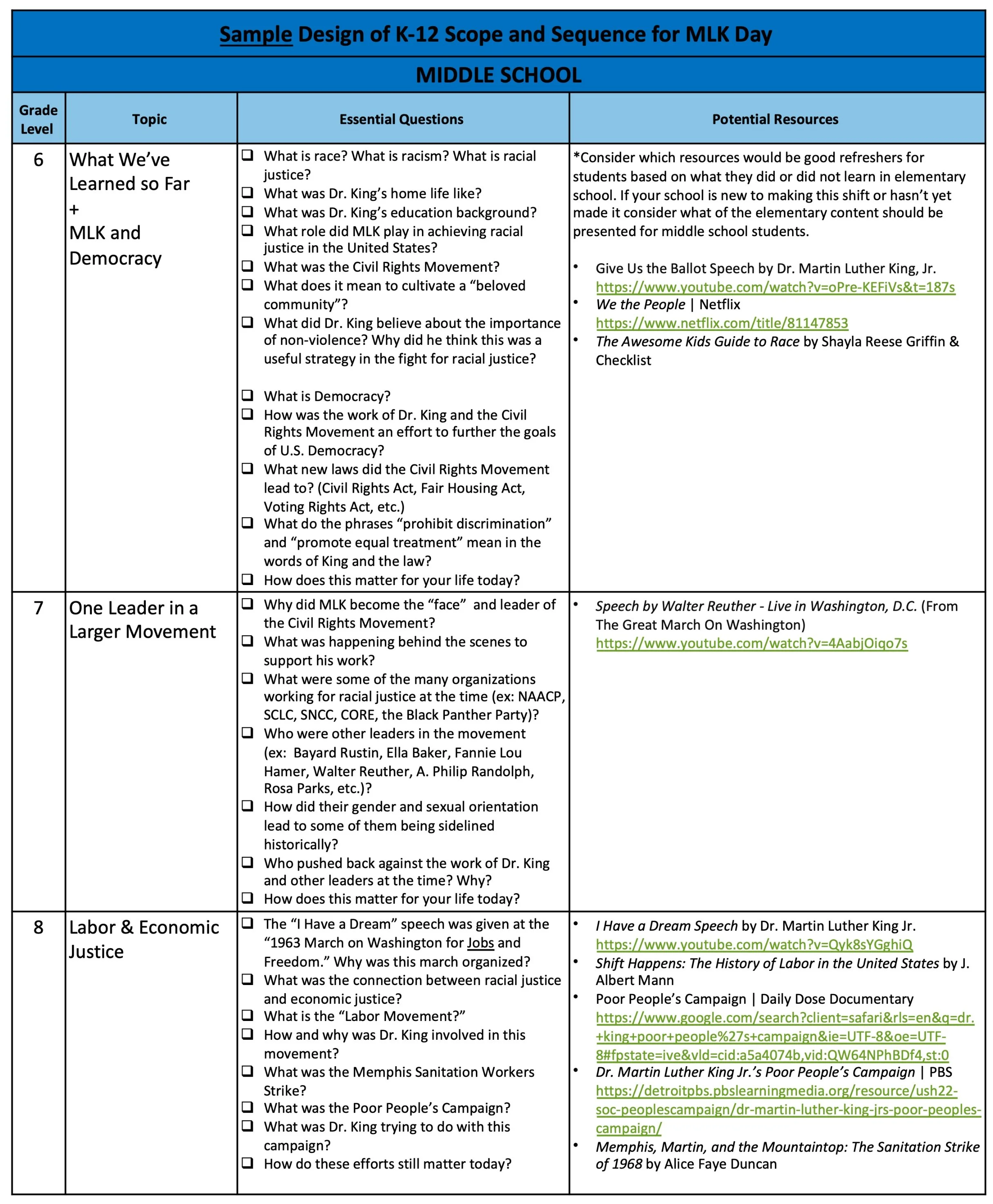
Sample Scope & Sequence Middle School
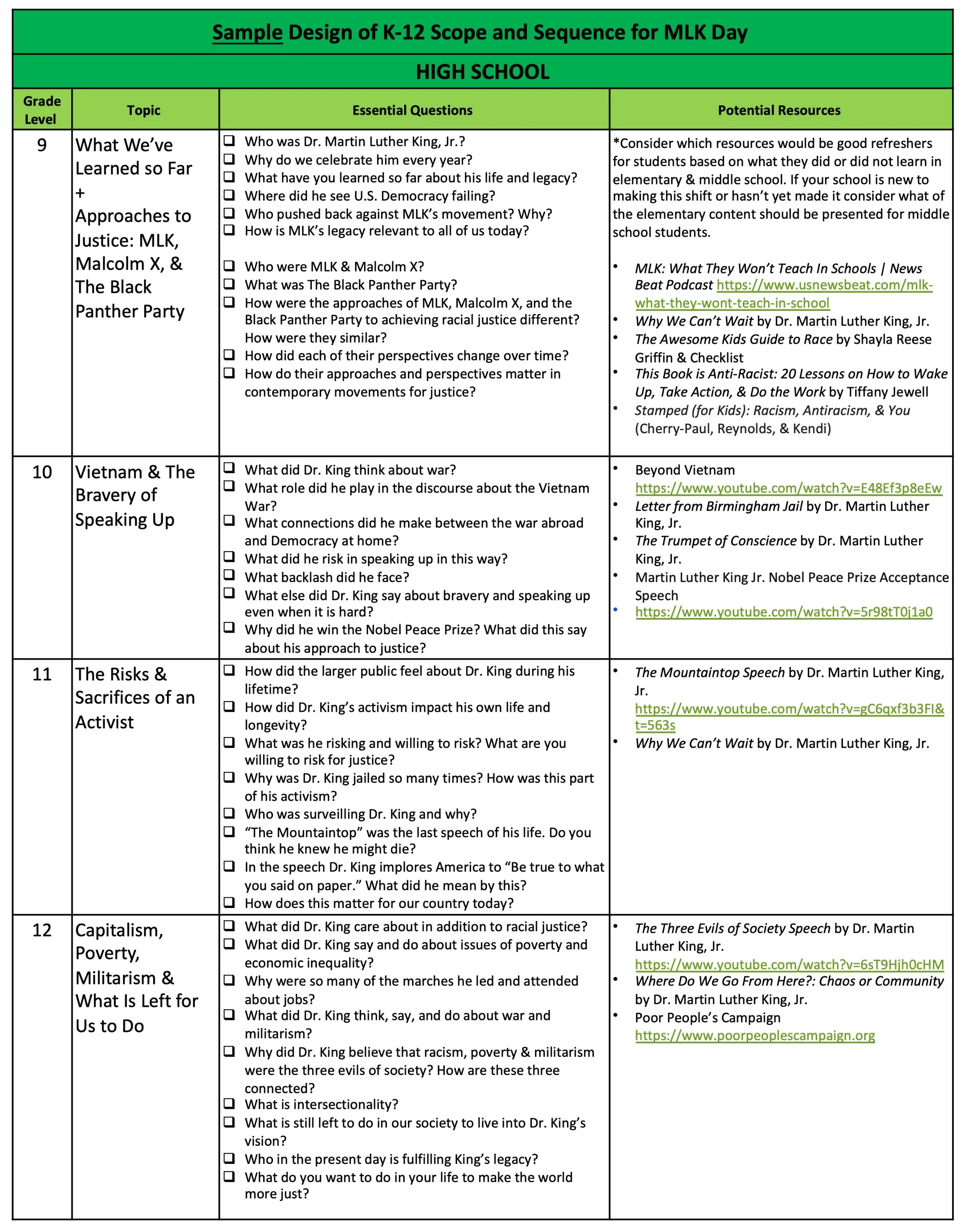
Sample Scope & Sequence High School
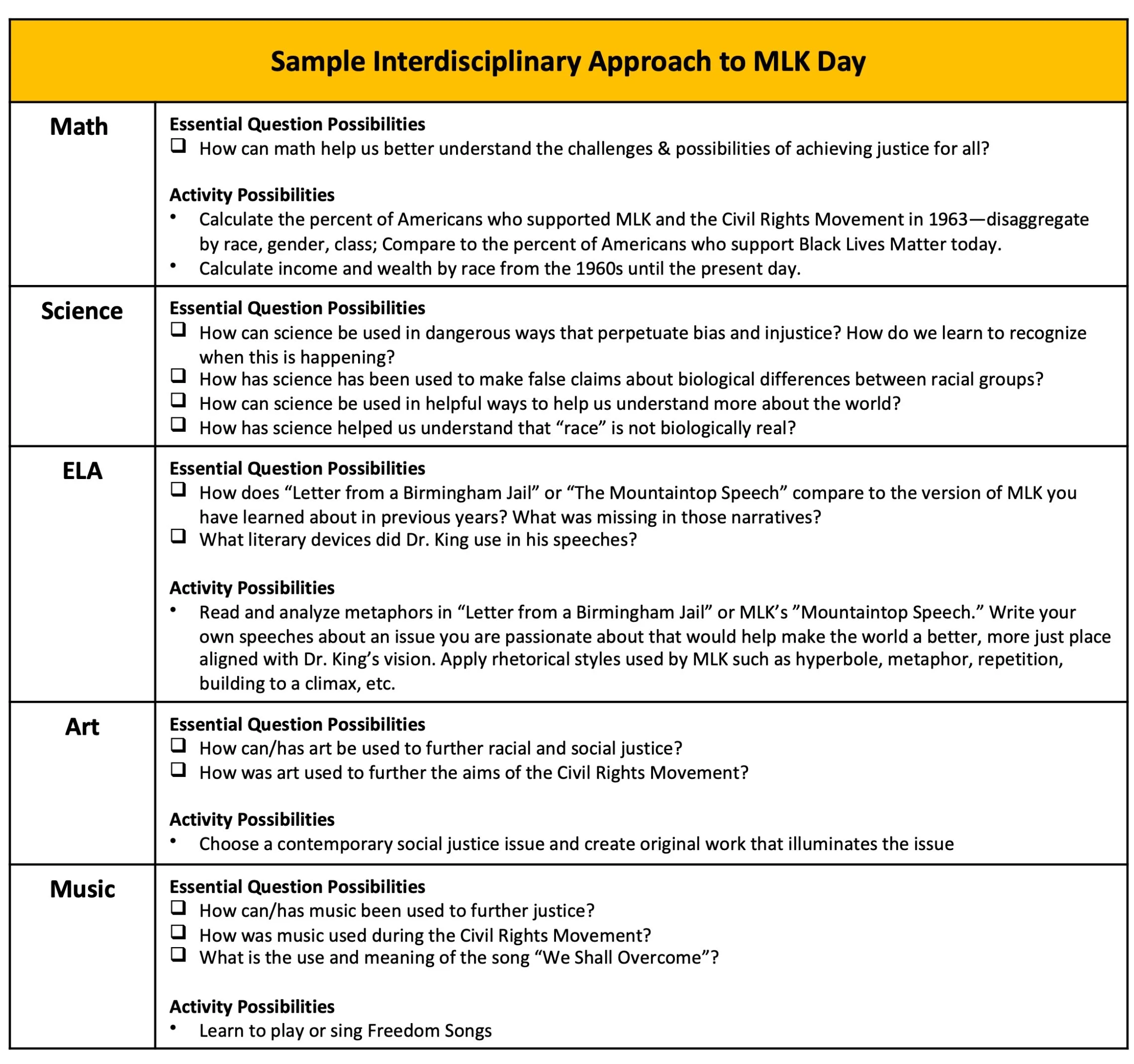
Change 5 | We Should Plan Across Disciplines!
Finally, our ultimate goal as educators should be to incorporate MLK content in interdisciplinary ways across subject areas and grade levels. Especially in secondary schools, it often becomes “the job” of Social Studies teachers to teach MLK (or not). Rather than delegating MLK to just one subject area, schools should consider how the life and legacy of Dr. King is relevant across subjects and for students beyond elementary school. Some possibilities are in the chart below:
Conclusion
Whether you’re rethinking and redesigning how you approach MLK Day as a school or district or just reconsidering your approach in your own classroom or home, our hope is that we better honor the life, legacy, and ultimate sacrifice of Dr. King by educating the next generation to deeply understand what he stood for, in his own words, and that we help our students cultivate their own commitment to equity and justice for all!
A few tips as you get started:
Consider how you need to prepare your students to engage with the life and work of Dr. King. If you haven’t already done so, you should develop classroom norms or guidelines for dialogue; engage in proactive relationship building (our Relationships Initiative may be helpful for both); and engage in social emotional learning to help students process what they will be learning (our support activities that accompany my book Feel: A Short Guide to A Lot of Emotions for Awesome Kids can help get you started!)
Do your own learning about Martin Luther King, Jr. so you are learning and growing along with your students!
Do your own learning about issues of race, racism, and racial justice in advance so that you feel prepared to answer students’ questions and inquiries. While it’s fine to say that you don’t know something and to then collaborate with your students to discover some of the answers to their questions, the barrier to their learning should not be our adult discomfort or lack of knowledge and reflection.
Consider playing full portions of MLK’s speeches in his own voice or reading full essays or books written by Dr. King. Many are available online for free!
Consider how your lessons may meet state and Common Core Standards in Social Studies, English Language Arts, and even Math, Science, Art, Music, and more! There are lots of ways to align what you do on this day to your broader teaching goals and expectations.
Finally, if you want support in your efforts to redesign MLK Day from Justice Leaders Collaborative contact us about our professional development workshops on “Redesigning MLK Day for Equity & Justice,” “Understanding Race & Racism” and more; about our coaching and consulting options; about our books, standards, and resources; or to be added to our mailing list for future resources and offerings! Good luck!
Resources
Curriculum & Lesson Planning Resources
The King Center | Classroom Resources (includes K-12 Curriculum for teaching MLK) https://thekingcenter.org/what-we-do/classroom-resources/
AFT | MLK Activities at Share My Lesson https://sharemylesson.com/collections/martin-luther-king-jr-activities
Learning For Justice | The Best of Our Dr. Martin Luther King, Jr. Resources https://www.learningforjustice.org/magazine/the-best-of-our-dr-martin-luther-king-jr-resources
NEA | Learning and Living the Legacy of Martin Luther King, Jr.: Lesson plans, activity ideas & other resources for teaching MLK Day https://www.nea.org/professional-excellence/student-engagement/tools-tips/learning-and-living-legacy-martin-luther-king-jr
New York Times | Teaching and Learning About Martin Luther King Jr. https://www.nytimes.com/2020/01/15/learning/lesson-plans/teaching-martin-luther-king-jr.html#link-4193998f
News Beat Podcast | MLK: What They Won’t Teach In Schoolshttps://www.usnewsbeat.com/mlk-what-they-wont-teach-in-school
NPR | 5 MLK speeches you should know. Spoiler: ‘I Have a Dream’ isn’t on the list https://www.npr.org/2024/02/07/1228320048/black-history-mlk-speeches-martin-luther-king
PBS | Martin Luther King JR. Day Classroom Resources https://www.pbs.org/newshour/classroom/lesson-plans/2025/01/martin-luther-king-jr-day-classroom-resources
Notable Speeches & Writings by Dr. King
SPEECHES
I Have a Dream Speech by Dr. Martin Luther King Jr. https://www.youtube.com/watch?v=Qyk8sYGghiQ
The Mountaintop Speech by Dr. Martin Luther King, Jr. https://www.youtube.com/watch?v=gC6qxf3b3FI&t=563s
The Three Evils of Society Speech by Dr. Martin Luther King, Jr. https://www.youtube.com/watch?v=6sT9Hjh0cHM
Beyond Vietnam https://www.youtube.com/watch?v=E48Ef3p8eEw
Martin Luther King Jr. Nobel Peace Prize Acceptance Speech https://www.youtube.com/watch?v=5r98tT0j1a0
WRITINGS
Where Do We Go From Here?: Chaos or Community by Dr. Martin Luther King, Jr.
Why We Can’t Wait by Dr. Martin Luther King, Jr.
The Trumpet of Conscience by Dr. Martin Luther King, Jr.
Letter from Birmingham Jail by Dr. Martin Luther King, Jr.
Additional Resources
BOOKS
The Awesome Kids Guide to Race by Shayla Reese Griffin
Bodies: A Short Guide to How We’re Different for Awesome Kids by Shayla Reese Griffin
Care: A Short Guide to Caring & Sharing for Awesome Kids by Shayla Reese Griffin
I Am Ruby Bridges by Ruby Bridges
Lift As You Climb: The Story of Ella Baker by Patricial Hruby Powell
Memphis, Martin, and the Mountaintop: The Sanitation Strike of 1968 by Alice Faye Duncan
My Brother Martin by Christine King Farris
Stamped (for Kids): Racism, Antiracism, & You by Cherry-Paul, Reynolds, & Kendi
Shift Happens: The History of Labor in the United States by J. Albert Mann
Side by Side/Lado a Lado: The Story of Dolores Huerta and Cesar Chavez by Monica Brown
Sit-In: How Four Friends Stood Up by Sitting Down by Andrea Davis Pinkney & Brian Pinkney
This Book is Anti-Racist: 20 Lessons on How to Wake Up, Take Action, & Do the Work by Tiffany Jewell
Together: A First Book About Race for Awesome Kids by Shayla Reese Griffin
TEACHING GUIDES
Start Here, Start Now: A Guide to Antibias and Antiracist Work in Your School Community by Liz Kleinrock
Race Dialogues: A Facilitator’s Guide to Tackling the Elephant in the Classroom by Kaplowitz, Griffin & Seyka
Textured Teaching: A Framework for Culturally Sustaining Practices by Lorena Escoto Germán
The 1619 Project Curriculum https://pulitzercenter.org/lesson-plan-grouping/1619-project-curriculum
RESOURCES
Checklist for Awesome Antiracist Kids (& Grownups Too!) https://www.justiceleaderscollaborative.com/store/p/checklist-for-awesome-antiracist-kids-grownups-too
VIDEOS
Bayard Rustin: An unsung hero of the civil rights movement — Christina Greer https://www.youtube.com/watch?v=NJcUnXTaCgU
Can Kids Change the World? | The Civil Rights Movement https://www.youtube.com/watch?v=8b3Y9xVvQzw
Dr. Martin Luther King Jr.’s Poor People’s Campaign | PBShttps://detroitpbs.pbslearningmedia.org/resource/ush22-soc-peoplescampaign/dr-martin-luther-king-jrs-poor-peoples-campaign/
Important Figures in Black History: A. Philip Randolph Biography https://www.youtube.com/watch?v=UdMiP9OQvpU
Kids tell the Herstory of Grace Lee Boggs, Detroit Activist — Radical Cram School S2 E1 https://www.youtube.com/watch?v=t5TFcvB-kZg
Poor People’s Campaign | Daily Dose Documentary https://www.google.com/search?client=safari&rls=en&q=dr.+king+poor+people%27s+campaign&ie=UTF-8&oe=UTF-8#fpstate=ive&vld=cid:a5a4074b,vid:QW64NPhBDf4,st:0
Speech by Walter Reuther — Live in Washington, D.C. (From The Great March On Washington) https://www.youtube.com/watch?v=4AabjOiqo7s
Walter Reuther’s Role in the Civil Rights Movementhttps://www.youtube.com/watch?v=z29DEceWX6g
We the People | Netflix https://www.netflix.com/title/81147853
Xavier Riddle & the Secret Museum: Rosa Parks & Thurgood Marshall | PBS https://www.youtube.com/watch?v=M4myMo8s9vQ
Shayla Reese Griffin, PhD, MSW is co-founder of Justice Leaders Collaborative & Press, which are committed to dismantling oppression, cultivating justice, and nurturing wellbeing through social justice training, consulting, resources, and books. Shayla is the author of many Short Guides for Awesome Kids including Feel, Care, Bodies and Outside; Together: A First Book about Race for Awesome Kids; The Awesome Kids Guide to Race; and the adult books Those Kids, Our Schools: Race and Reform in An American High School and Race Dialogues: A Facilitator’s Guide to Tackling the Elephant in the Classroom. She lives with her spouse and three children and gets her best ideas at 3 am.
Learn more about her work at www.justiceleaderscollaborative.com and www.justiceleaderspress.com.