
We’re Not All Middle Class: The Rise of Populism and Prices Should Push Us to Help Our Kids Cultivate Class Consciousness
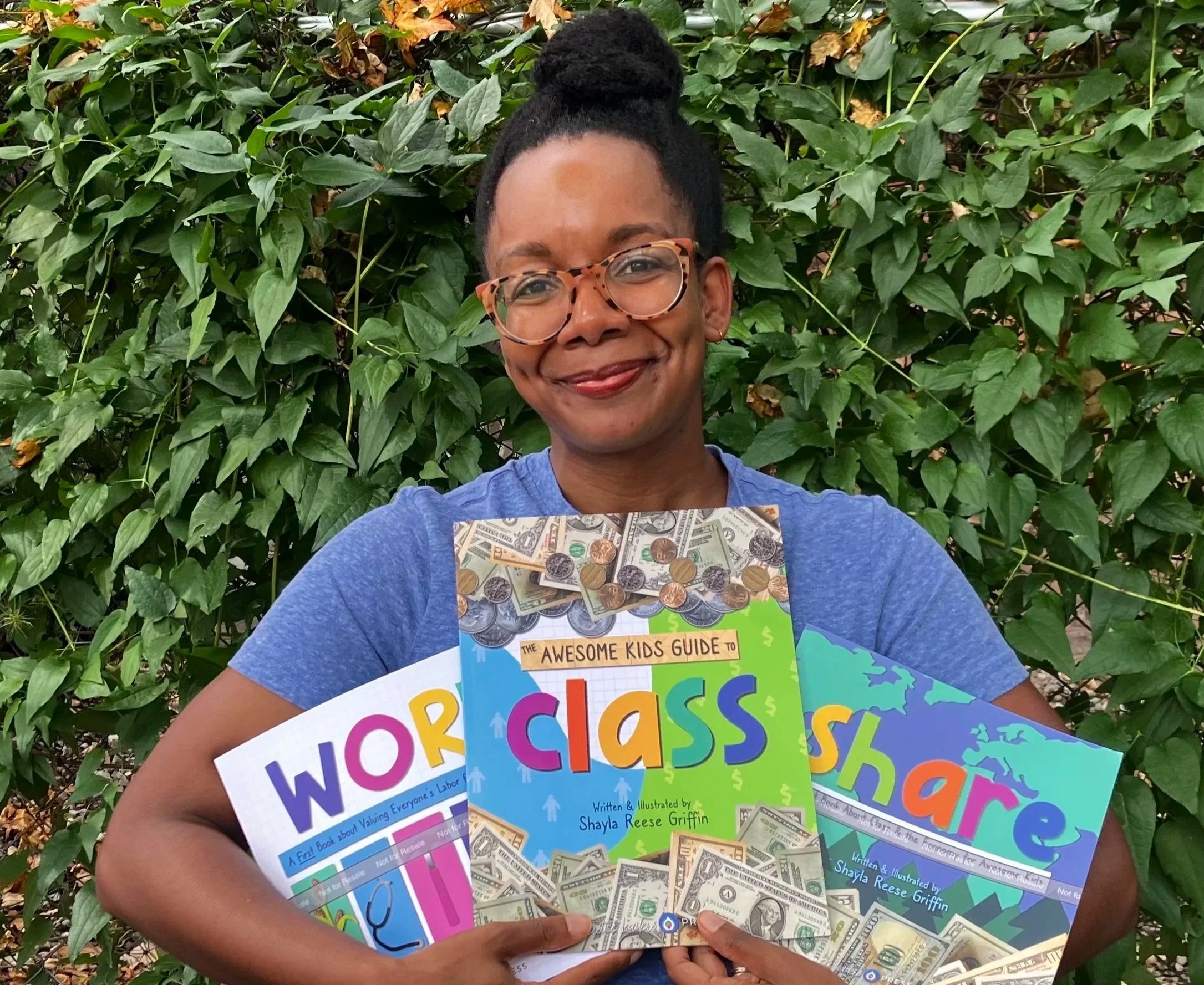
Shayla Reese Griffin holding the proofs of her new book babies, The Awesome Kids Guide to Class, Share: A First Book About Class & the Economy for Awesome Kids, and Work: A First Book About Valuing Everyone’s Labor for Awesome Kids. Available for pre-order in hardcover, paperback, and ebook!
When I was a social work intern in one of the largest urban public school districts in the country almost twenty years ago, I tried talking to the high school students I worked with about class. It did not go well. I thought of myself as “middle class,” and from my perspective my students were clearly from families who were not thriving economically in the U.S. context. Standard economic measures would have agreed. (For context: when I enrolled my own child in the same district years later, a staff member explained how parents managed pick-up when school ended before 3pm and offered no aftercare by saying, “Honestly, most of our parents are unemployed.”) And yet, as I tried to help my students consider income, wealth, status, and inequality in our society, they adamantly insisted that they too were “middle class.”
My students and I were not alone. Unlike the diversity of ways people identify along lines of race, gender, or ability, being “middle class” is an identity that most Americans seem to claim, regardless of our actual economic positions.
“Middle class” is an identity that most Americans seem to claim, regardless of our actual economic positions.
In other countries this isn’t the case. There are many places around the world in which social justice consciousness and activism have primarily focused on class inequality. And yet, despite the powerful history of the U.S. labor movement–a history that most of us don’t actually know much about–Americans writ large are lacking such perspective.
I’ve found that people like my former students who struggle financially, people who are objectively well-off, and those in between, all tend to say we’re “middle class.” Most of us think there are a few very very poor people, a few very very rich people, and the rest of us. And we almost all consider ourselves part of “the rest of us”—not too poor (which we believe would be sad but mostly our own fault due to our failure to ‘work hard enough’), and not too rich (which we believe would be a bit tawdry and gauche, even if we’re not so secretly planning what we’ll do when we finally ‘get rich’). Instead, we’re all somehow “just right.”
In my work at Justice Leaders Collaborative facilitating social justice workshops with adults, it is almost always the case that when we get to the topic of class–which we define as money plus social status–our participants have a lot of big feelings. Sadness, anger, and rage at how unfair our society is, but also shock. For the majority of participants, our session is the first time they’ve really given much thought to class. Sure, they think about how to pay their bills, what they can afford to buy, or where they can afford to travel–money at an individual or family level–but they haven’t really considered the broader economic system under which we all live.
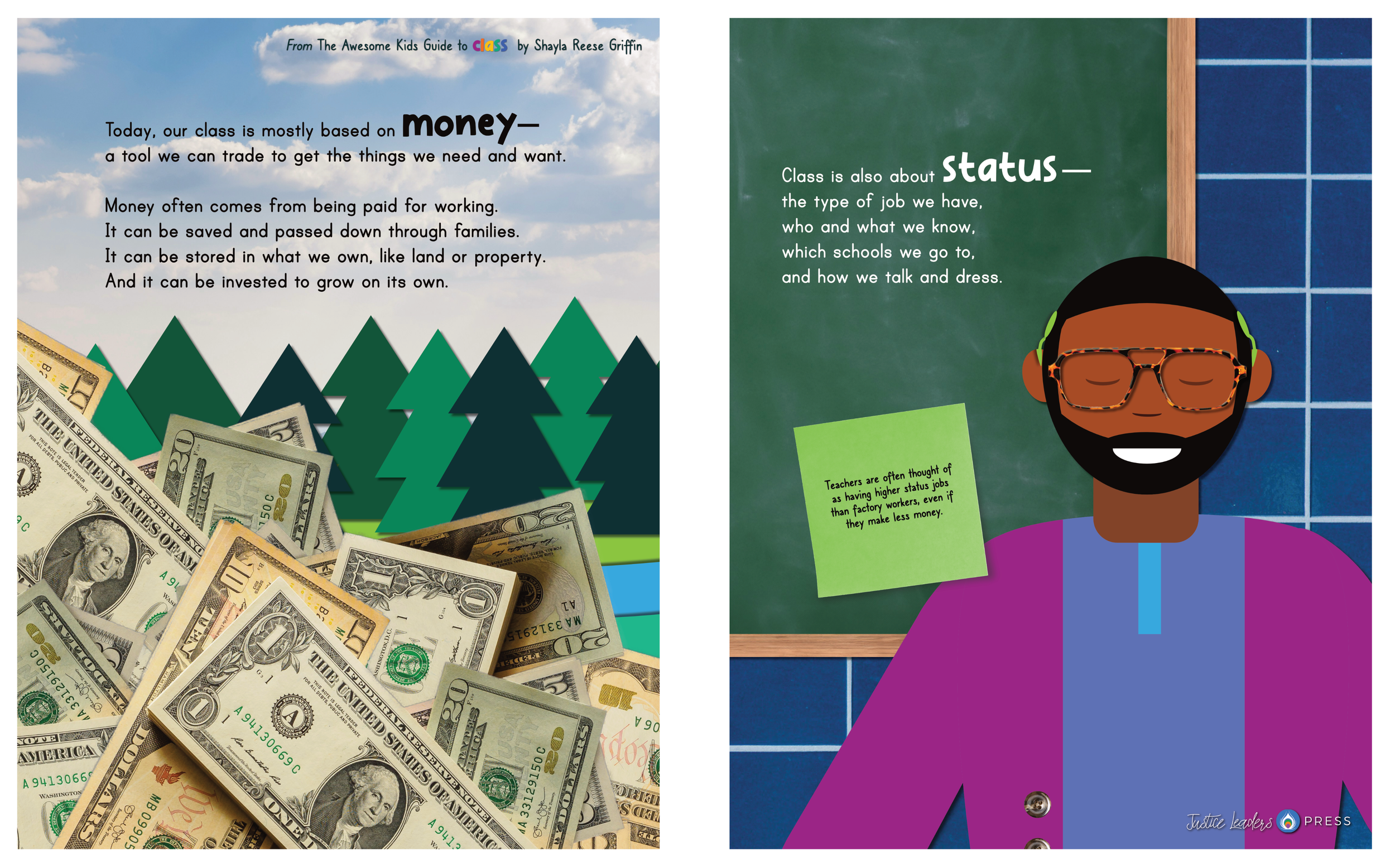
Two pages from the book The Awesome Kids Guide to Class explaining that class is about money and status.
Even among the justice- and diversity-minded adults we work with, who are in the room because they care deeply about racial justice or LGBTQIA+ rights, the class day is always an emotionally hard one.
Ironically, the issues of justice that many of us have given more thought to fundamentally come back to class. Why is racism such a horror? Not just because Black, Indigenous, and other People of Color are too often mistreated in interpersonal interactions, or fail to be represented positively in the media, but primarily because Black, Indigenous, and Latine people on average have only a fraction of the wealth of White people, even after building much of this country’s infrastructure. (Reference my first children’s book, The Awesome Kids Guide to Race, for more on this).
Why? One big reason is that much of the work they did went unpaid or underpaid for hundreds of years. American slavery was a system of labor–work that produced astronomical wealth; and the racism underpinning slavery was a tool used to justify the violent exploitation of those workers and the hoarding of that wealth among an elite few (along with the resources, status, and opportunity it produced).
Another reason is that our laws allow people to pass down wealth intergenerationally to their children, and their children’s children, and their children’s children’s children. Meaning that if your family profited or suffered from the slave labor system 200 years ago, you’re likely still profiting or suffering today.
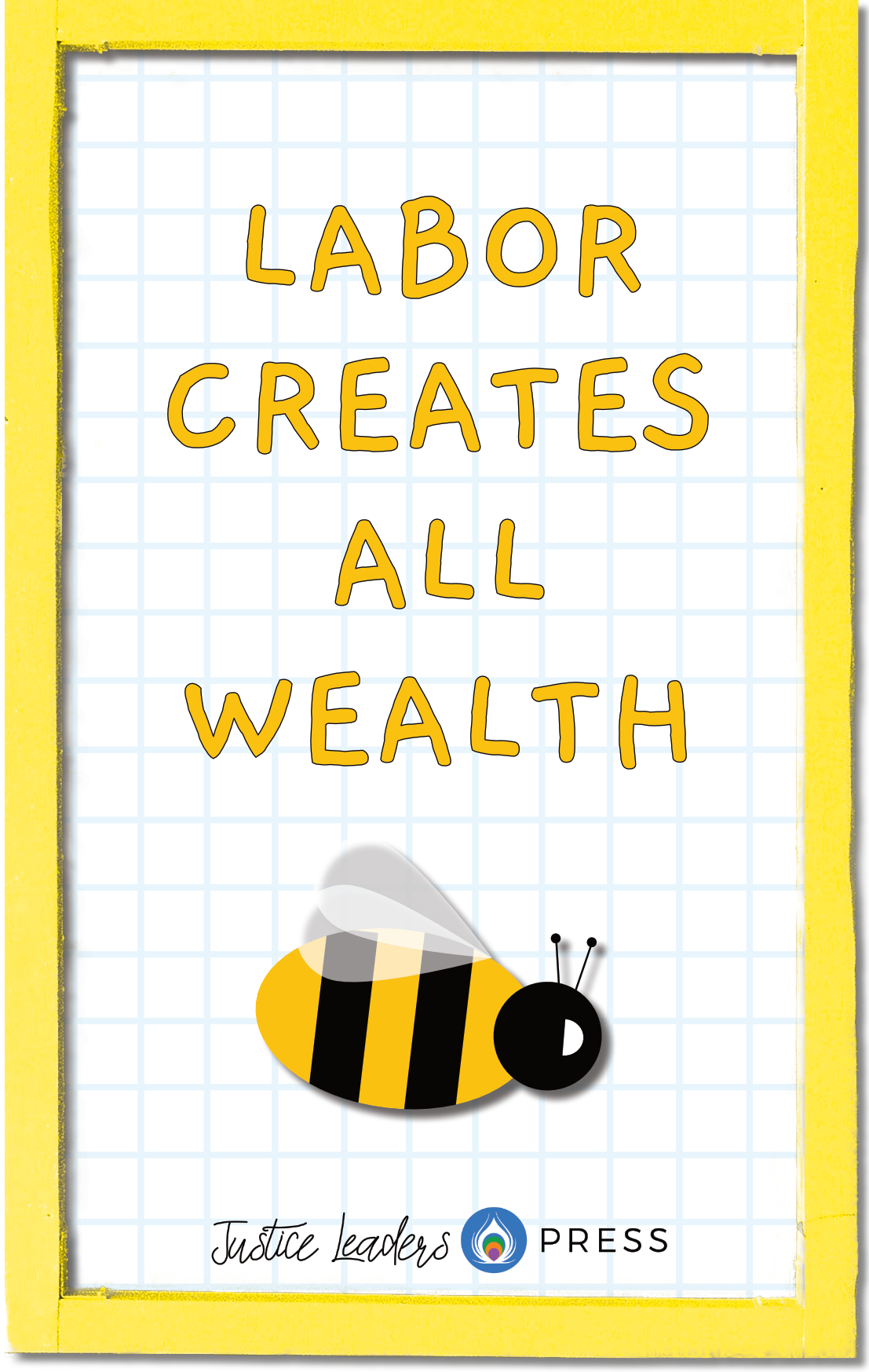
A poster that says “Labor Creates All Wealth” and features a picture of a bee from the book The Awesome Kids Guide to Class.
Recently, one of my children independently put these pieces together: “Wait, wait, wait…are you telling me that all slavery ever in history was really just about money?!” I’d never thought about it in exactly these terms–9-year-olds have a way of getting to the meat of a thing. After a bit of thought I responded, “Yeah, that’s pretty much what I’m telling you.” Even in instances in which systems of slavery weren’t explicitly about dollars and cents, they were about work, about power, about status–about class.
The same is true for most of the “-isms.” Sexism–the oppression of women–and ableism–the oppression of people with disabilites–are problems in large part because of the detrimental impact they have on the financial lives of women and people with disabilities (look up “sub-minimum wage” as an example).
When we do the math, it’s almost always the case that groups who experience discrimination and oppression have less wealth. Racism, sexism, and ableism manifest as class inequality. Or, as they say, follow the money.
Racism, sexism, and ableism manifest as class inequality. Or, as they say, follow the money.
If we had a social safety net that ensured everyone could meet our shared human needs for food, water, shelter, and care (I have a picture book on that too), there’d be less concern with how much money any one of us had. We would all be “middle class” in a way. But as I write in two of my new picture books (The Awesome Kids Guide to Class and Share), our current system of class determines:
“the food we can eat,
the place where we sleep,
if we can go to the doctor,
or get or teeth cleaned,
if we live in a home with enough books to read,
if we have the best toys,
and even how we’re perceived.”
Or to put it another way, our class impacts literally every aspect of our lives.
And yet opportunities to learn about class as a form of systemic inequality are practically nowhere to be found in our public, charter, or homeschools, or even in our homes! When class is addressed—as it innovatively was in an 8th grade social studies class that my friend’s child took last year—the focus is on budgeting better, or making sure you get good grades so that you can get “a good job.” On individual lives and decision-making. There is no systems analysis.
What are young people learning about why our system allows some to have so much, while others have so little? We’re giving kids few ways to make sense of passing a person asking for money on the street corner while hearing on the radio that Elon Musk is the world’s first trillionaire—and, more importantly, how they fit into it all—perhaps because we ourselves can’t see the forest for the trees.
Not only are we failing to teach (or learn) about class, most of us live very economically segregated lives, which makes it even harder to take honest account of our social positions. Many of my students who couldn’t fathom that they were not “middle class,” had never traveled even to the downtown of the city where they lived. And many of the wealthier people who lived in remodeled high rises downtown would never in a million years be caught in my students’ neighborhood.
Class is relative, which can make it pretty challenging to figure out where we fit. Siloed in our own limited social circles, it’s easy to believe we’re in the middle of it all. Our inability to take in the whole picture is a big part of why we struggle to build sustained movements around the economic inequality staring us in the face. If class is a pointillist painting, most of us are just seeing dots (What does this reference say about my class position?).
Instead of collectively organizing for economic justice, we parrot lines about individual “hard work,” because what we’ve actually been taught is: “work hard” and YOU will have a lot of money. Ironically, we say we believe this even when we’re the people working hard for not very much money. To quote one of my favorite memes: “Make it make sense!” (What does this reference say about my class position?)
The truth is that the hardest working people I know are not middle class. The people who work long unpredictable hours, often overnight, doing treacherous physical labor that can lead to disabling injuries, under threat of real physical violence (have you ever witnessed a conflict between a bus driver and an irate passenger?), are usually getting paid less than it costs to live, even when working full-time jobs, and frequently lack access to things like basic healthcare, childcare, and elder care (full-time work, no vacation days, no sick days at the federal minimum wage adds up to only about $15,000 per year; In contrast, a livable wage in the state where I live is more like $50,000 per year for one person). How many of our children know this? How many of us do?
Of course, middle and upper middle class people like myself work hard too! I’ve put a lot of hard work into writing, and sometimes illustrating, books for kids (and grownups too!) trying to explain these concepts in understandable and visually stimulating ways. My kids have said they feel the hardness of my work is bordering on “obsessive” (they’re very good at unsolicited feedback). And some middle and upper middle class people are at increased physical risk–educators and healthcare workers can face violence in the workplace. But it’s a different kind of hard. Any honest look at the world through the window of my (home) office (with a new sliding door my spouse built to give me a bit more privacy. I’m still deciding on art for the walls and whether or not I should get a small area rug to make the space more in line with my HGTV dreams…)—makes that clear pretty quickly.
The view through my window is quite beautiful. I’ve spent years cultivating my flower garden and it’s really thriving. One of my neighbors, on what I describe to people as “the most economically integrated block in the country,” snarkily said to me that “it must be nice” to have the luxury of time, ownership, and space to "garden." She was right. It is nice. And also pretty messed up (the point she was actually trying to make). Not necessarily that I have the luxury, but that she doesn’t, and that some people have even more–a person managing their gardens on their behalf—while others have even less–like the person in the alley next to us looking for cans in the garbage to exchange for coins while we were talking. (I’m counting at least four different class positions in just this one anecdote).
I’ve done way more beautifying of my front yard than my back yard in part because I want my neighbors to also benefit, which many of them appreciate. (Note how “neighbor” always seems to mean “housed person.”) Our above ground pool is in the back though. My snarky neighbor’s point remains. Class is always messy, as was that interaction.
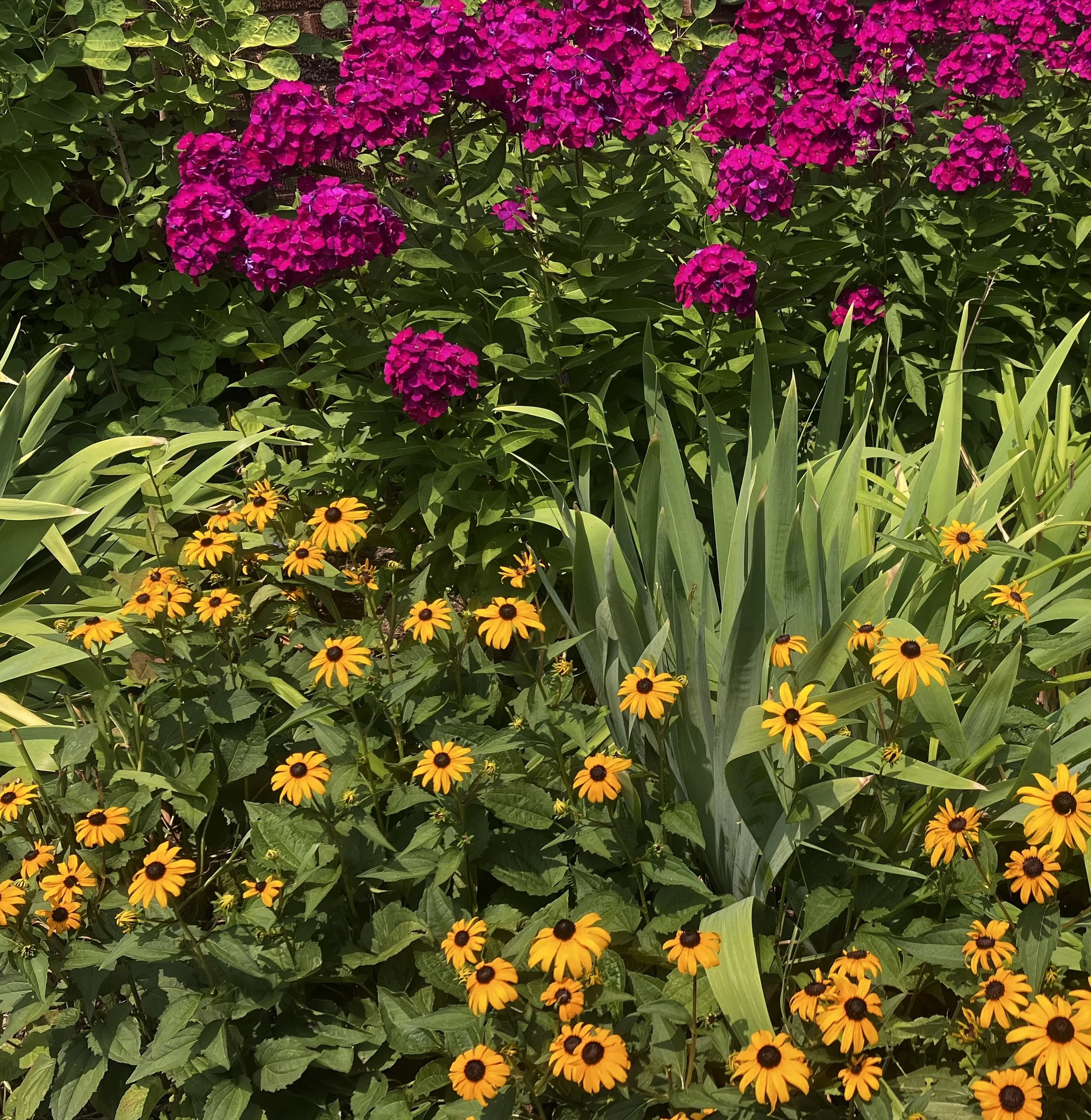
My flower garden. Pictured: Black-eyed Susans, Phlox, and the foliage of Irises, Daylilies, and Smokebushes
When we don’t build strong collective economic justice movements we start looking for people to blame for the injustice we feel but can’t clearly name—sometimes it’s immigrants, other times our neighbors who have time for flowers (I think “gentrifiers” is the word I’m looking for). For me these interactions are a reminder to do the work of talking to my own children about class. Why do we have a garden while most of our neighbors don’t? Why do we live in a house with a yard–front and back–while many other children on the block live in apartment buildings with no green space at all? How much does it cost to maintain a pool? Why is there an electronic gate across the entrance of the condo building down the street but not in front of the apartment building?
One difficulty when it comes to class and economic justice is that to make any real sense of it we’re always needing to look both “up” at those who have more than us, and “down” at those who have less—and we need to do so slowly enough to notice the multiple levels that exist on each side of the divide.
I just went on a walk around my (economically integrated) neighborhood and in only a few minutes passed sleeping structures of people who were unhoused, income-based apartment buildings, market-rate apartment buildings, 100-year-old single family homes & duplexes, and million dollar condos (I think we’re at 5 class positions in this one. According to the graph of wealth by population in my book, The Awesome Kids Guide to Class, that’s about right).
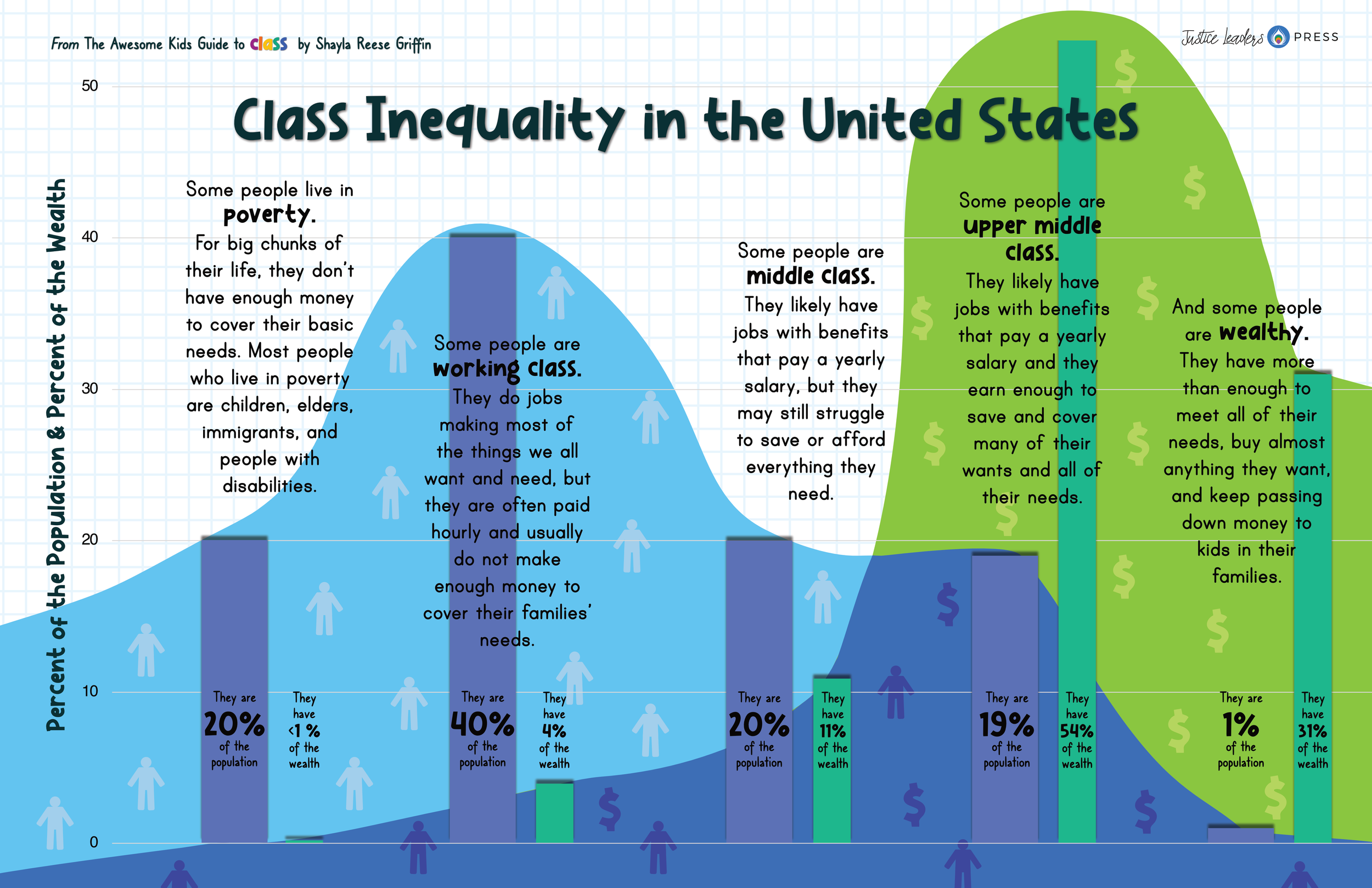
Graph of “Class Inequality in the United States”—Percent of the Population & Percent of the Wealth from The Awesome Kids Guide to Class.
But, as I’ve noted, most of us aren’t looking much at graphs. As a society, we don’t like math. We’ve just been looking in the mirror.
When we avoid considering class in any deep way, we also avoid engaging our children in doing so. We act as if they aren’t living in and observing this very same messy world. We let them believe that the money their families have is either their entitlement or their fault, when in fact it’s largely the result of the economic system we’ve put in place–a system we don’t actually talk to them about. Our society has decided that some people can get paid less than $8 an hour for full time jobs (and if they have certain disabilities less than $3/hr). There’s only so much “hard work” and "bootstrapping" can do in such conditions.
These silences, omissions, and sometimes outright lies about class fester until they boil over into our anger, our discontent, our disconnection, and our voting. An election is (once again) upon us. And the conversation surrounding it thus far has mostly been about class. “Populism” really just boils down to people feeling that their social and economic status—their class—is unfair, that they don’t have enough to meet their needs, that the inequality has gotten too great and too noticeable, that the prices have gotten too high. And so, feeling quite powerless, we save up all of our anger for our neighbors and for the ballot box, where too many of us vote for our prejudices rather than for our collective pocketbooks (for example, we’d really all benefit if everyone could get the healthcare they need). Or we actually don’t–40% of Americans don’t vote even for president, because we aren’t all that confident that anything can change through electoral politics.
There is more we could do though (in addition to voting–which we should definitely do). We could stop the mis- and missing information at the source. We could raise children who have both beautiful, fun, adventurous, and joyful childhoods, but who also grow up with a deeper, more accurate, more critical understanding of class. We could help these children build relationships with each other. We could support them in developing the tools to be innovative and justice-minded when it’s their turn to be in charge of the economic system we all live under.
If you asked my three children they’d tell you the new picture books I’ve written about class, classism, and economic justice aren’t their favorites. After all, there aren’t really any jokes in them, despite their continual pressure for me to add more “fart content.” But they’ve been some of my favorites because since I’ve started working away on these books (Very hard! Maybe obsessively so!), I’ve had so many conversations about class with my children that I’m not sure we would have naturally stumbled upon otherwise. (Let me know at justiceleaderscollaborative@gmail.com if you want to know more about the things we’ve discussed and maybe I’ll do a Part II).
My children, ages 8, 9 & 11, are interested in starting a business that I cannot reveal due to pending copyright protections for #childrensideasTM. We’ve talked about how you calculate the amount of money you must make if you want to hire employees, how much those employees need to be paid in order to earn a living wage, and what it would cost to provide them with health insurance. The kids are, rightly, feeling concerned about the profit margins of justice. I can empathize as a fellow entrepreneur. As I said, class is messy.
We’re deep in the mess of class dialogue over here, and it brings me such joy to be in it with the truly awesome kids in my life. I hope my new class books, The Awesome Kids Guide to Class, Share: A First Book About Class & the Economy for Awesome Kids, and Work: A First Book About Valuing Everyone’s Labor for Awesome Kids (along with Care: A Short Guide to Caring & Sharing for Awesome Kids), bring the same messy joy to your classrooms, homes, families, and communities.
Our children deserve to understand the world they live in (in age appropriate ways). They deserve to learn much earlier than we did “the truth, that individual hard work alone can’t fix a system built on inequality,” (that’s in one of the books 😉). They deserve to feel empowered to change the system, like the many awesome activists who came before them. And they deserve to know that actually, we’re not all middle class—that’s not how middles work, as most of them could tell you.
Download the FREE Economic Justice Checklist to accompany The Awesome Kids Guide to Class!
Take & Share the Pledge to Talk to the Kids in Your Life about Class!
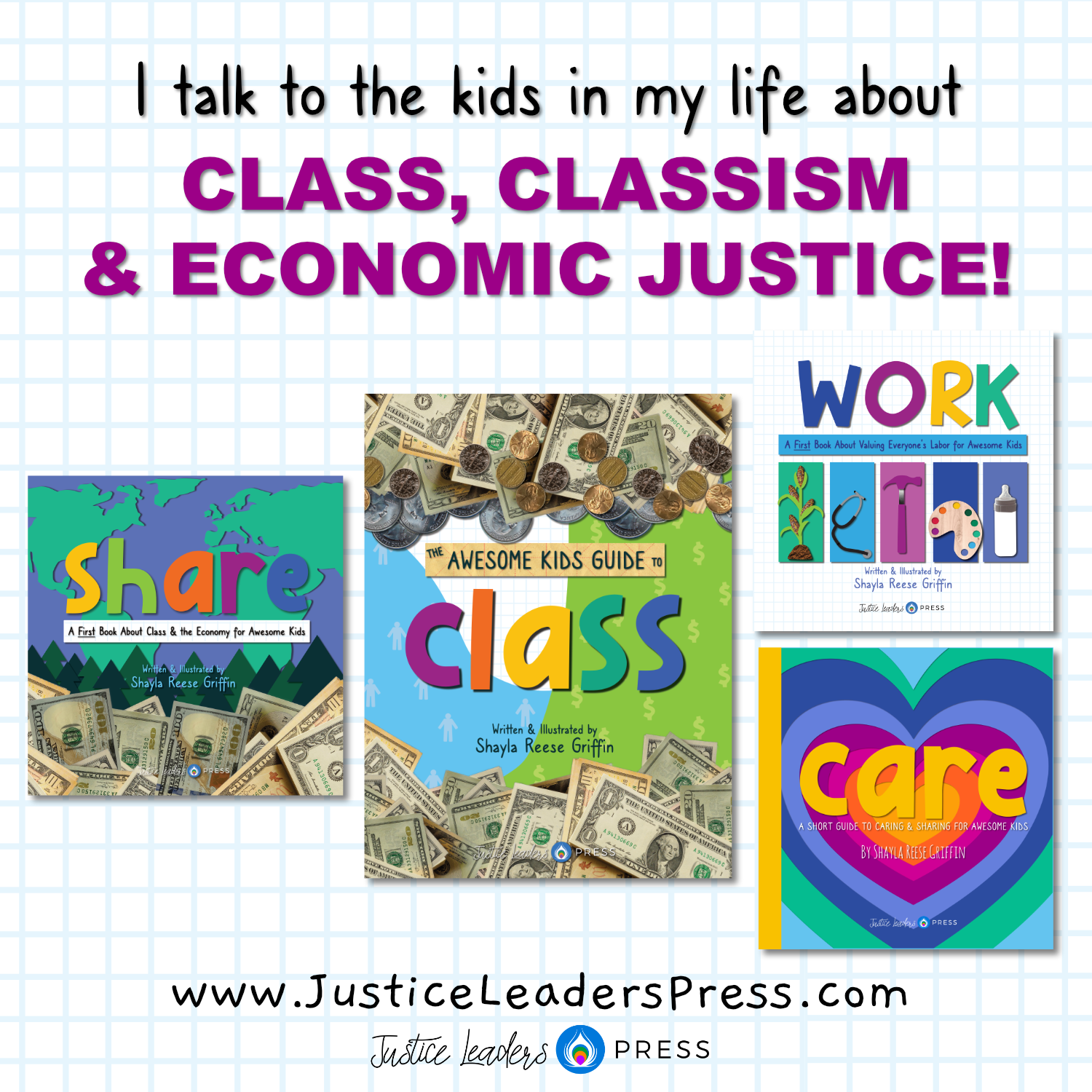
“I talk to the kids in my life about class, classism, & economic justice” with pictures of the covers of The Awesome Kids Guide to Class, Share, Work, & Care by Shayla Reese Griffin. Feel free to post on your social media or share with the people in your life!
All three new books are available for PRE-ORDER Labor Day, September 7, 2026 in hardcover, paperback, and special discounted bundles from JusitceLeadersPress.com and from all major retailers wherever books are sold online including Bookshop, Thriftbooks, and Barnes & Noble. They will be available widely on October 6, 2026 in hardcover, paperback, and ebook, and by request at your local libraries.
If you enjoy my work and want to learn more don’t forget to visit www.JusticeLeadersPress.com to join the Justice Leaders mailing list and get all of my latest updates, books, and FREE resources.
And don’t forget to visit our store to download FREE discussion guides, lessons, and activities to accompany the books!
The Awesome Kids Guide to Class
Paperback ISBN: 978-1-969646-82-9
Hardcover ISBN: 978-1-969646-81-2
Ebook ISBN: 978-1-969646-83-6
Share: A First Book About Class & the Economy for Awesome Kids
Paperback ISBN: 978-1-969646-85-0
Hardcover ISBN: 978-1-969646-84-3
Ebook ISBN: 978-1-969646-86-7
Work: A First Book About Valuing Everyone’s Labor for Awesome Kids
Paperback ISBN: 978-1-969646-88-1
Hardcover ISBN: 978-1-969646-87-4
Ebook ISBN: 978-1-969646-89-8
Care: A Short Guide to Caring & Sharing for Awesome Kids
Hardcover ISBN: 978-1-969646-92-8
Paperback ISBN: 978-1-969646-93-5
Ebook ISBN: 978-1-969646-94-2
Shayla Reese Griffin, PhD, MSW is co-founder of Justice Leaders Collaborative & Justice Leaders Press, which are committed to dismantling oppression, cultivating justice, and nurturing wellbeing through social justice training, consulting, resources, and books. Shayla is the author of many books and resources for children and adults. She lives with her spouse and three children and gets her best ideas at 3 am.
Learn more about her work at www.justiceleaderscollaborative.com and www.justiceleaderspress.com.